I was working, really, trying to find useful details about gangs for a story I'm editing, and found a television tropes result...always worth following if you have an hour.
I wound up at "anvilicious" which has a fairly plain meaning about obvious messages thinly disguised as or in entertainment.
My concise definition has its merits, but there's just something about browsing tvtropes. Don't forget to click on the examples buttons below. It's a clunky interface, but the interwoven content will have you opening a dozen simultaneous tabs in no time.
About Me

- Steve Shea
- A 40-ish publisher (editor, project manager, etc.), husband, and father of an even number of offspring, I grew up, or failed to, reading fantasy and sci-fi. I still enjoy reading, and now am trying to write. My favorite books include YA fantasy, manga, biography, and advice to authors. I'm also a former history major/grad student/high school teacher and assessment writer. Now I work for a school supplement publisher, specializing in high-low chapter books. I spend a lot of my time controlling reading levels. At night, I cut loose and use long words. W00t!
Monday, June 20, 2011

Thursday, June 16, 2011
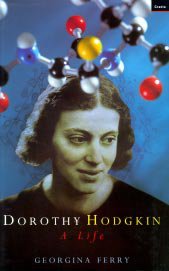
Dorothy Hodgkin: a life, by Georgina Ferry
Dorothy Crowfoot Hodgkin seems like the kind of person who merits duelling biographers, Every page of Ferry's dully titled, well-ordered, and crisply phrased seemed packed with Hodgkin's own energy. From a young age, Dorothy Hodgkin, born Crowfoot, seems to have been working at an accelerated rate, driven by curiosity and enabled by intellect and good fortune (her encouraging and liberal family, her family's fortuitous financial circumstances, the contacts and possibilities presented to her), she left her biographer the happy task of way too much to write about at once.

I felt at times an unhappy comparison with my own accomplishments, or more precisely, with my own drive.
Hodgkin (1910-1994) is principally famous for mapping the structure and composition of a few major organic molecules, especially penicillin, vitamin B12, and human insulin. She did this through a field of physical chemistry I had not understood at all prior to reading Ferry's account, x-ray crystallography.
The process involves triggering crystal formation in the target molecule (I really have no sense how this is done), isolating crystals of it, firing x-rays through the crystals, and catching the refractions on photographic paper. The crystal is turned a number of times and new refractions captured. Careful analysis of the patterns leads to testable hypotheses in some cases, and with numerous follow-ups, even complex molecules can be mapped - not only the composition understood, but the locations of atoms, and even arrangements of electrons. Considering the finesse of the task, or the stark differences proceeding from small chemical changes, this is quite a difficult and a useful endeavor.
Hodgkin was also notably a magnet, a catalyst, a principal cause. She should be equally famous for her ability to charm and convince people to give her, and other scientists, often women or non-Europeans, opportunities. She broke (and trampled to dust) several barriers, or stormed the walls with the first wave (she was the third woman inducted into the Royal Society). Once established, she made her laboratory a site of cross-pollenization, a platform for unattached scientists, and the development of new ideas. Her own work and the work she inspired, supported, and often (later) funded, opened up fields of inquiry.
This brings me to my motivation in reading this dense and informative decade-old biography. I was trying, and I failed, to find the source of a quotation I'm probably misremembering. It may go like this,
However, I have enjoyed reading what feels like intellectual history raiding the land of biography.
I felt at times an unhappy comparison with my own accomplishments, or more precisely, with my own drive.
Hodgkin (1910-1994) is principally famous for mapping the structure and composition of a few major organic molecules, especially penicillin, vitamin B12, and human insulin. She did this through a field of physical chemistry I had not understood at all prior to reading Ferry's account, x-ray crystallography.
The process involves triggering crystal formation in the target molecule (I really have no sense how this is done), isolating crystals of it, firing x-rays through the crystals, and catching the refractions on photographic paper. The crystal is turned a number of times and new refractions captured. Careful analysis of the patterns leads to testable hypotheses in some cases, and with numerous follow-ups, even complex molecules can be mapped - not only the composition understood, but the locations of atoms, and even arrangements of electrons. Considering the finesse of the task, or the stark differences proceeding from small chemical changes, this is quite a difficult and a useful endeavor.
Hodgkin was also notably a magnet, a catalyst, a principal cause. She should be equally famous for her ability to charm and convince people to give her, and other scientists, often women or non-Europeans, opportunities. She broke (and trampled to dust) several barriers, or stormed the walls with the first wave (she was the third woman inducted into the Royal Society). Once established, she made her laboratory a site of cross-pollenization, a platform for unattached scientists, and the development of new ideas. Her own work and the work she inspired, supported, and often (later) funded, opened up fields of inquiry.
This brings me to my motivation in reading this dense and informative decade-old biography. I was trying, and I failed, to find the source of a quotation I'm probably misremembering. It may go like this,
The value of a good bit of work is that it inspires imitation, and is soon eclipsed.To me, that encapsulates quite well the attitude of the Nobel Laureate Hodgkin. I began to be interested in her story principally to check this quotation. Having now, finally, finished reading the book, I can't say I'm much closer.
However, I have enjoyed reading what feels like intellectual history raiding the land of biography.
Monday, June 6, 2011
MORI Kaoru's Bride's Story (manga)
I love this book. I read unlicensed scanlations of it online, and considered buying Mori's earlier series, Emma, just to support her, even though the story didn't captivate me.
So I was thrilled when Yen Press came out with a (hardbound!) collection of the beginning of the story, and immediately bought vol. 1. I can't wait for vol. 2.
What makes this so captivating? First it's the art. Mori draws in a shojo (think: really big eyes) style, but way off to the extreme of detail and style. There's none of the sparkly silliness, the super-deformed comedic moments, the school-uniforms-and-cherry-blossoms sameness of her art, or her subject.
Bride's Story is set around the Caspian Sea in the 19th century, with Russia and England pursuing their "Great Game" in the area, which impinges on the story subtly at first. Mori draws scenery like an Italian Renaissance painter, with details of hills stretching out to the horizon. I've never been to the Caspian Sea region, but now I want to go.
She also paid exquisite attention to details of costume, architecture, and material culture. Even were she to have gotten the details wrong, you can't help on reading this to admire the wealth of detail. I'm inclined to think she got it right, at least mainly, because of the elements that ring true to me, but I really don't know.
The story is full of challenges, difficulty, and warmth - even romance. (Yes, it's really a shojo manga!) But it's also full of action (at first, and often, provided by the bride of the title), which makes it look and read more like a shonen manga, for boys. But at its heart it's far more serious. It's really a grown-ups' story, or at least YA. The action and themes are mature, including the marriage in question (what's shocking to readers is the youth of the husband; what's shocking to people in the story is the age of the bride), and the relations between different groups of nomads and townspeople.
I've read through chapter 10 of the scanlation (which I am now avoiding because it's licensed in the US), and will definitely invest in the remainder of the series.
So I was thrilled when Yen Press came out with a (hardbound!) collection of the beginning of the story, and immediately bought vol. 1. I can't wait for vol. 2.
What makes this so captivating? First it's the art. Mori draws in a shojo (think: really big eyes) style, but way off to the extreme of detail and style. There's none of the sparkly silliness, the super-deformed comedic moments, the school-uniforms-and-cherry-blossoms sameness of her art, or her subject.
Bride's Story is set around the Caspian Sea in the 19th century, with Russia and England pursuing their "Great Game" in the area, which impinges on the story subtly at first. Mori draws scenery like an Italian Renaissance painter, with details of hills stretching out to the horizon. I've never been to the Caspian Sea region, but now I want to go.
She also paid exquisite attention to details of costume, architecture, and material culture. Even were she to have gotten the details wrong, you can't help on reading this to admire the wealth of detail. I'm inclined to think she got it right, at least mainly, because of the elements that ring true to me, but I really don't know.
The story is full of challenges, difficulty, and warmth - even romance. (Yes, it's really a shojo manga!) But it's also full of action (at first, and often, provided by the bride of the title), which makes it look and read more like a shonen manga, for boys. But at its heart it's far more serious. It's really a grown-ups' story, or at least YA. The action and themes are mature, including the marriage in question (what's shocking to readers is the youth of the husband; what's shocking to people in the story is the age of the bride), and the relations between different groups of nomads and townspeople.
I've read through chapter 10 of the scanlation (which I am now avoiding because it's licensed in the US), and will definitely invest in the remainder of the series.
Sunday, June 5, 2011
Sticker Shock - it's more than just the price of the car
This morning's NYT editorial, "Sticker Shock," makes one great point, and I think misses another, with this central assertion:
That said, I think there's a bit missing to the editorial, and it's about how the market regulates itself. There's a kind of ecosystem for products that drives the producers to change, or not. That ecosystem contains market forces and government regulations. The market forces are undeniable. That's why the world buys so many Toyotas, despite recent problems (which have reduced Toyota sales).
But what I think is wrong with the statement I quoted, and with the general perception of market forces and manufacturing, is that producers in one regulatory setting react less well to the market forces than producers in another. That is, the reason American producers (as the editorial states) withhold information, and other consumer-centered improvements, is that the regulatory environment in the United States permits them to survive that way.
No longer forced to compete by hunting, the US car industry has become tame, living hand-fed in the shelter of regulatory neglect.
Companies that respond without that insulating blanket develop more fuel-efficient, lower-emission cars. They do this without the appearance of government regulation.
So the anti-regulatory crowd in the US has it exactly backwards. The denial of sensible regulatory pressure on auto (and other) producers IS the market distortion. Sensible regulations allow consumers and producers to act rationally in the marketplace.
Labels [in this case, about car mileage and emissions] can help consumers make better choices. But Detroit and other manufacturers make big changes only when regulators force them to.The value of this insight is plain, and often denied by market fetishists. If we're going to have competition in a high-volume consumer setting, the least the consumer needs is good information about the products she is consuming. Can you assess the safety of the eggs you buy? Do you test the processor speed of a computer before purchasing it? I will make better (more market-oriented) consumer choices when I have useful information. How else can the invisible hand act but in the light?
That said, I think there's a bit missing to the editorial, and it's about how the market regulates itself. There's a kind of ecosystem for products that drives the producers to change, or not. That ecosystem contains market forces and government regulations. The market forces are undeniable. That's why the world buys so many Toyotas, despite recent problems (which have reduced Toyota sales).
But what I think is wrong with the statement I quoted, and with the general perception of market forces and manufacturing, is that producers in one regulatory setting react less well to the market forces than producers in another. That is, the reason American producers (as the editorial states) withhold information, and other consumer-centered improvements, is that the regulatory environment in the United States permits them to survive that way.
No longer forced to compete by hunting, the US car industry has become tame, living hand-fed in the shelter of regulatory neglect.
Companies that respond without that insulating blanket develop more fuel-efficient, lower-emission cars. They do this without the appearance of government regulation.
So the anti-regulatory crowd in the US has it exactly backwards. The denial of sensible regulatory pressure on auto (and other) producers IS the market distortion. Sensible regulations allow consumers and producers to act rationally in the marketplace.
Thursday, June 2, 2011
The Case of the Left-handed Lady / An Enola Holmes Mystery, by Nancy Springer
I always prejudge a book by its cover. This gets me into trouble some of the time, and keeps me out of quite wonderful reads much of the rest of the time, but it is hard not to do.
One of my hats at work says "art director" on it. I have a sympathy with, well, myself, for the above failing.
This said, and while I very much liked the particular cover (I know of three) of The Case of the Left-Handed Lady that I borrowed from the library, I actually picked it up because of the author and the subject matter. How crazy is that?
Nancy Springer is a fine writer of middle grades fiction. She has written a number of stories about horses, one of which I reviewed recently, and which was part of the reason I picked up this one. The Enola Holmes mysteries suppose a teenage sister of the adult Sherlock, who experiences sleuthing in Victorian England, as they said of Ginger Rogers, "backwards and in high heels."
Springer has done a great job in this second (perhaps third) novel in the series of defining a character on the go, and describing her universe in digestible, almost unnoticeable chunks. I intend to copy her to the letter in my work, one day. We meet Enola in mid-dissembling, and chase her through her adventures doubly fraught with the dangers of discovery and societal disapproval as well as murder and the damn smog.
It's a nice piece for someone who can follow the deceptions (they're not hard), and comprehend the differences between Victorian England and the reader's own society. Springer deftly assigns the lead character to the task of tut-tutting those elements of modern American self-image that had roots in the novel's time, but had not come to pass.
I can't guess a word count, but this would be a nice step up for a fourth to sixth grader who's not yet feeling confident, or reading quickly, enough for middle teen novels of 80k words.
One of my hats at work says "art director" on it. I have a sympathy with, well, myself, for the above failing.
This said, and while I very much liked the particular cover (I know of three) of The Case of the Left-Handed Lady that I borrowed from the library, I actually picked it up because of the author and the subject matter. How crazy is that?
Nancy Springer is a fine writer of middle grades fiction. She has written a number of stories about horses, one of which I reviewed recently, and which was part of the reason I picked up this one. The Enola Holmes mysteries suppose a teenage sister of the adult Sherlock, who experiences sleuthing in Victorian England, as they said of Ginger Rogers, "backwards and in high heels."
Springer has done a great job in this second (perhaps third) novel in the series of defining a character on the go, and describing her universe in digestible, almost unnoticeable chunks. I intend to copy her to the letter in my work, one day. We meet Enola in mid-dissembling, and chase her through her adventures doubly fraught with the dangers of discovery and societal disapproval as well as murder and the damn smog.
It's a nice piece for someone who can follow the deceptions (they're not hard), and comprehend the differences between Victorian England and the reader's own society. Springer deftly assigns the lead character to the task of tut-tutting those elements of modern American self-image that had roots in the novel's time, but had not come to pass.
I can't guess a word count, but this would be a nice step up for a fourth to sixth grader who's not yet feeling confident, or reading quickly, enough for middle teen novels of 80k words.
Wednesday, May 18, 2011
Incarceron/Sapphique - Catherine Fisher
I read the first volume on a business trip (to exhibit at the International Reading Association Convention, no less), and fell instantly into the world Fisher creates. When I got back, I bought the second volume on the way home from the airport. I finished it the day after my Florida flu fever broke.
Part of what held my attention so thoroughly was the mysterious nature of the world itself. The central question of the book is, really, its setting. All the previews will tell you that Incarceron is a prison world, and the main characters are a prisoner and the Warden's daughter. This is good enough to get going, but the way Fisher repeatedly trips up the reader, with possible red herrings and genuine deceptions, keeps the story building tension even though the action could hardly have started sooner.
I felt the resolution fell short, however, and it's a bit of my sci-fi>fantasy prejudice showing through. I like to know, at the end, what happened, and to have reasons and causal relationships. Much of fantasy relies on the unknowable (exception: the highly rational and organized magic of the Harry Potter universe), whereas at least some science fiction relies on rational, if not naturalistic, explanations.
For those not burdened with my predilections (and are they even reasonable?), this short series is a detailed tapestry of interwoven narratives (talk about omniscient perspective head-hopping...but it works!), glimpses of imagined sacred texts and histories, and a deep, changing, meaningful world for deep, changing, and meaningful characters to inhabit.
Maybe my reservation of praise over the plot resolution has to do with the fact that I've rewritten my own first chapter (again) based on the experience of the first volume alone. Totally unfair of me. These are great fantasy.
Part of what held my attention so thoroughly was the mysterious nature of the world itself. The central question of the book is, really, its setting. All the previews will tell you that Incarceron is a prison world, and the main characters are a prisoner and the Warden's daughter. This is good enough to get going, but the way Fisher repeatedly trips up the reader, with possible red herrings and genuine deceptions, keeps the story building tension even though the action could hardly have started sooner.
I felt the resolution fell short, however, and it's a bit of my sci-fi>fantasy prejudice showing through. I like to know, at the end, what happened, and to have reasons and causal relationships. Much of fantasy relies on the unknowable (exception: the highly rational and organized magic of the Harry Potter universe), whereas at least some science fiction relies on rational, if not naturalistic, explanations.
For those not burdened with my predilections (and are they even reasonable?), this short series is a detailed tapestry of interwoven narratives (talk about omniscient perspective head-hopping...but it works!), glimpses of imagined sacred texts and histories, and a deep, changing, meaningful world for deep, changing, and meaningful characters to inhabit.
Maybe my reservation of praise over the plot resolution has to do with the fact that I've rewritten my own first chapter (again) based on the experience of the first volume alone. Totally unfair of me. These are great fantasy.
Saturday, April 30, 2011
The Boy on a Black Horse, by Nancy Springer
I'm editing books on horses, targeted for teen girls. Actually, I fought for the series, came up with the characters, the setting, and most of the plot outlines, found an artist, leveled the manuscripts, and I am now supervising the artist I selected while finishing the editing process and commissioning the cover design.
The problem is - well, problems are - I'm not a teenage girl, and I don't like horses.
I rode one once, for maybe half an hour. Then I was in a hospital for a few days. That was over three decades ago, and even with Facebook, I don't recognize most of the people I went to grade school with. They post these nice pictures, and I think, "who's that?" with almost every name and face.
The horse's name - the one that threw me: Brandy. Yes. I can remember that.
So I'm not a devotee of the genre, it may safely be said. I thought it might be good to check if we were doing it right, and last week I finally checked out a somewhat dated book by a fairly prolific author of girls' fantasy books, mainly with horses, and dove in.
It was great! Springer is one of those authors who, like Suzanne Collins, believes in grabbing the viscera in the opening lines. Nothing, for me, starts off like The Hunger Games. But Springer's The Boy on a Black Horse starts with that same, simmering power, the feeling of loss, and promise of danger.
Every part of that opening works. There's suspense, questioning, romance, mystery, characterization... I can see where, over the next few paragraphs, Collins has done Springer one better, by showing the near ends of all the final threads immediately, and quickly turning dread into relief into panic. This doesn't progress like that, but instead quietly, calmly introduces Gray Calderone's motivations and history, about at the pace a real person might on meeting someone new, and coming to trust them.
Anyway, the purpose of reading this book was not to enjoy it, though I really did. It was to check on Copper Canyon, my series of short books for struggling older readers. (I say "my" - I'm not the author, and Deb did a great job, but for the purposes of writing a high interest-low reading level book, I have to take out every word or phrase and replace it with another. I call it "fossilization." Not the most promising verb, but a good metaphor for the process.) I am pleased as much by the comparison as by the research. Now I get to go back to the editing, and not worry whether the books will be enjoyable. (There's plenty else to worry about in publishing, anyway!)
The problem is - well, problems are - I'm not a teenage girl, and I don't like horses.
I rode one once, for maybe half an hour. Then I was in a hospital for a few days. That was over three decades ago, and even with Facebook, I don't recognize most of the people I went to grade school with. They post these nice pictures, and I think, "who's that?" with almost every name and face.
The horse's name - the one that threw me: Brandy. Yes. I can remember that.
So I'm not a devotee of the genre, it may safely be said. I thought it might be good to check if we were doing it right, and last week I finally checked out a somewhat dated book by a fairly prolific author of girls' fantasy books, mainly with horses, and dove in.
It was great! Springer is one of those authors who, like Suzanne Collins, believes in grabbing the viscera in the opening lines. Nothing, for me, starts off like The Hunger Games. But Springer's The Boy on a Black Horse starts with that same, simmering power, the feeling of loss, and promise of danger.
The first time I ever saw him I was pretending to write in my daily journal in language arts class but actually drawing a horse--the head and neck had come out run-in-the-wind gorgeous, but I knew I would never get the rest of it as good--and when the door opened I looked up like everybody else, and there was a strange boy walking into my life.
Every part of that opening works. There's suspense, questioning, romance, mystery, characterization... I can see where, over the next few paragraphs, Collins has done Springer one better, by showing the near ends of all the final threads immediately, and quickly turning dread into relief into panic. This doesn't progress like that, but instead quietly, calmly introduces Gray Calderone's motivations and history, about at the pace a real person might on meeting someone new, and coming to trust them.
Anyway, the purpose of reading this book was not to enjoy it, though I really did. It was to check on Copper Canyon, my series of short books for struggling older readers. (I say "my" - I'm not the author, and Deb did a great job, but for the purposes of writing a high interest-low reading level book, I have to take out every word or phrase and replace it with another. I call it "fossilization." Not the most promising verb, but a good metaphor for the process.) I am pleased as much by the comparison as by the research. Now I get to go back to the editing, and not worry whether the books will be enjoyable. (There's plenty else to worry about in publishing, anyway!)
Subscribe to:
Posts (Atom)