About Me

My photo
A 40-ish publisher (editor, project manager, etc.), husband, and father of an even number of offspring, I grew up, or failed to, reading fantasy and sci-fi. I still enjoy reading, and now am trying to write. My favorite books include YA fantasy, manga, biography, and advice to authors. I'm also a former history major/grad student/high school teacher and assessment writer. Now I work for a school supplement publisher, specializing in high-low chapter books. I spend a lot of my time controlling reading levels. At night, I cut loose and use long words. W00t!
Showing posts with label fantasy. Show all posts

Tuesday, February 5, 2013

Yellow-Face in Fantasy Audio


Two contemporary audio books I recently listened to while commuting surprised me with antiquated Chinese stereotypes. One of the odd things about this was that both were fantasy books. The characters, names, and concepts which stand out to me this way were not Chinese. They weren’t even Asian. They weren’t on Earth. What they were was “yellow-face.”

In Hollywood near the middle of the last century, Chinese were specifically excluded from permanent immigration to the US, except in miniscule numbers. Most immigration from China was limited to working men. This created a bachelor society that, along with its multigenerational effects, have been well-depicted in literature, especially Lisa See’s Shanghai Girls, Amy Tan’s The Joy Luck Club (also a movie), and Wayne Wang’s movie, Eat a Bowl of Tea. These books and movies fill in the missing Chinese side of the Chinese-American experience in mid-century and after.

However, because Chinese were missing, and yet so fascinating to non-Chinese Americans, something was required to fill the gap. The Chinese were missing because they were barred, but in movies (as in audio books), non-Chinese could temporarily become Chinese. Parallel to Anglo-Americans’ adoption of “blackface” to depict black characters (not black people) to audiences segregated by Jim Crow laws, white film actors donned “yellow-face” to depict Chinese characters (again, not Chinese people) to audiences segregated on the spot by Jim Crow-type laws and remotely by the Chinese Exclusion Act.

The most conspicuous Chinese protagonist in American films of the 1930s and ‘40s was designed to counteract negative stereotypes, but was not played by a Chinese actor. Earl Derr Biggers, who has too many r-controlled vowels in his name (a sound appearing, as far as I can tell, only in American English, Mandarin Chinese, and Korean, go figure), may have intended Charlie Chan to counteract the negative stereotypes of Chinese villains prominent in American depictions. These are so comical today that we hardly think of them, so good work, Mr. Biggers.

What we’re left with is a different range of stereotypes, including reflexive subservience, docility (or stoicism, or fatalism), unthinking adherence to tradition, and bad English skills. These featured prominently in Charlie Chan films, and yet the actors in those films were, at first, Japanese and Korean Americans, and later Swedish and Anglo Americans. The Japanese and Korean actors got one turn each, but the films were not successful. Then a Swedish actor, Warner Oland, took on the role and made it a succes. A series of Anglo actors took on the role in subsequent films (after Oland’s death and in radio dramas.

What does that matter for contemporary fantasy fiction? I’ve never seen a “Charlie Chan” film, read one of Biggers’ novels, or heard one of the derived radio dramas, and yet I am familiar with the character because the stereotype is pervasive. I know it through ripples and echoes. All the information above was in my own memory, with the exception of specific names. This is how stereotypes work – participants in a culture transmit them to each other, without reflection.

The two audio books I recently found echoing and rippling with Charlie Chan stereotypes were David Gemmell’s Hero in the Shadows, the ninth in a series I’d never paid attention to before, but not necessarily following on the eighth Tales of Drennai book, and Terry Pratchett’s Snuff, an otherwise entertaining and carefully knit-together continuation of the story of Detective Sam Vimes’s aspects of Discworld, also not required to be read in order.

In both cases, the authors made forceful points against prejudice, and yet included the Chinese stereotypes (rather, stereotypes of Chinese) of subservience, poor speech / understanding, and overadherence to tradition, and in each case the reader multiplied that by choosing vocal characterizations that fit the “yellow face” stereotypes associated with Charlie Chan.

One of the supporting characters in Snuff is a constable whose mother was born overseas, and who therefore has different language and food customs to draw on. Everybody is very complimentary of the mother’s cooking, but Pratchett makes a recurring joke of describing dishes that have very similar sounding names, and generally include the sounds “suck” and “dog.” So we get the dog-eating stereotype, along with mockery of Chinese names. I listened patiently throughout the book for Pratchett to use the names of the food, or the foods themselves, as a plot device, but as far as I can see he just returned to them time and again for what I consider to be a cheap laugh.

What would it be like for Pratchett to have joked about people who eat pickled fish and have names like Weinberg and Silverstein having long noses and being avaricious. Would readers think, “Oh, those merry Jews” and feel good about it?

The oddest thing about this is that overcoming prejudice is the major theme of Snuff. Pratchett introduces an icky characteristic (vessels for collecting substances removed or extracted from the body) of an unloved people (goblins) and makes his alter-ego Sam Vimes and the readers not only come to accept them, but appreciate them.

David Gemmell is less focused on combating prejudice in Hero in the Shadows, but oddly, his three Asian-ish characters (all from a land called “Chiatze”) all face discrimination by the locals, and get some form of revenge or satisfaction against that. It’s a strong minor theme. These important supporting characters are: Matze Chai (a reliably greedy merchant with “almond-shaped eyes,” an effeminate lifestyle, and a fatalism that helps him endure what he can’t overcome), Kysumu (a small-statured “rajnee warrior,” bred through extremes of technical proficiency and self-denial to carry on an ages-old tradition), and Yu Yu Liang (a “ditch-digger” the reader played like a Hong Kong movie comedy role).

Part of the characterization that made me think of Charlie Chan (though that was from ignorance – Warner Oland speaks quite loudly and clearly in the little scene I just looked up online) was the voice actor’s breathy speech for all of these three “Chiatze” characters. More than the other two, he represents Yu Yu as a bit buffoonish, his speech halting over Ls, Rs, and consonant blends, and his vowel sounds cut back to just five or six. I think the voice characteristics are more in keeping with Gedde Watanabe as Long Duk Dong in Sixteen Candles than with Warner Oland in the Charlie Chan films.

Both authors are pretty much off the hook for stereotyping complaints – Pratchett because the focus of Snuff is overcoming prejudice, and Gemmell because his three Asian-ish characters overcome prejudice, and the voice actor is not the same as the author. However, it feels odd to encounter stereotypes about Chinese in literature that doesn’t have any Chinese in it.

Wednesday, August 29, 2012

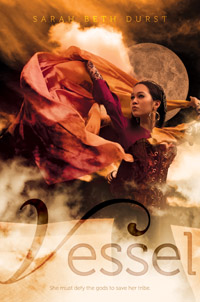
preview, VESSEL, by Sarah Beth Durst

I got sidetracked at work and followed a link to the sample chapters of a new fantasy novel, Vessel, by Sarah Beth Durst.


The book is due next month from Simon & Schuster, which continues to impress me with the quality and quantity of their YA offerings.

The premise is compelling: What if you prepared your whole life to become a sacrifice to a goddess that would save your people, and then the goddess did not accept your sacrifice?

The sample reads very well. The pace is great, and the descriptions draw a solid world, full of textures, smells, sounds, and characters. I have small quibbles with the dialogue and the use of alliteration. Small quibbles indeed.

The protagonist is a girl, about 16 years old, and I think the crossover appeal to boys would be less than for The Hunger Games, but it's still possible. Then again, I'm not a teenage boy, so I don't mind. 

The invitation that drew me in includes high praise from Tamora Pearce. If you're a fan of hers, as I am, this will certainly appeal.

Oh, and nice cover design.

Wednesday, June 20, 2012

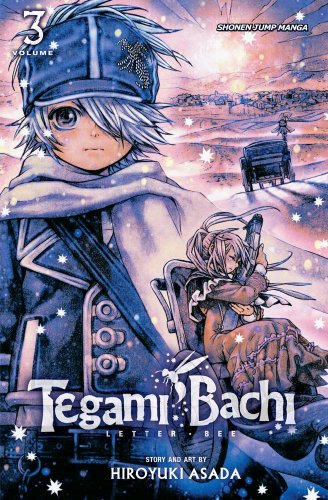
The Jump: Asada Hiroyuki’s TEGAMI BACHI, vols. 3-5


Tegami Bachi, aseries combining elements of off-kilter fantasy and science fiction inlushly-illustrated manga format, took awhile to get off the ground for me. I loved Asada’s heavily-lined, high-contrast, gloomy and angular art, and I was curious about the parceled-out world of Amberground and mystery of the disappearance of a character from the first volume.

The world-building, the suspense and mystery, the art—all of these grabbed me from the beginning, and I didn’t regret buying the volumes, except after the second volume, when I found the narrative wanting.

The focus of the series had apparently changed from one character to another, and the reasons why were not clear. However, after a few months, I missed the art, and picked up the third volume. I’m happy I’ve since bought through volume six (and just today ordered the next three).

The story is coming together better. More clues are revealed. The supporting characters are earning their spots in the narrative. We have liftoff.

For a while, the series felt weighed down also by the silly-sounding names. I realized a bit late that there is a pattern, of sorts, and though the names still sound ridiculous (I’ve written about Jiggy Pepper, a minor character, before, but one of the principal characters is named Gauche Suede, and there are more like that), the development of the protagonist and the hints about the disappeared character outweigh that for me now.

This is definite shonen manga material, with a child protagonist, missing parents, speed lines, obscure catch phrases, and very tame “fanservice” shots of a semi-human character who frequently disrobes. Tegami Bachi is published first in Shonen Jump magazine in Japan and the US, and brought out in volumes in Japanese, English, French, and Italian, at least.


Monday, November 14, 2011

Woe is... George R. R. Martin's Guilt-Ridden Cast of Thousands


George R. R. Martin’s Song of Ice and Fire series starts with betrayal, execution, and a subtly magical bond between animals and people. After A Game of Thrones and most of A Clash of Kings, I have to conclude that it will not let up. We join the tale when the strands are well enfolded, lines of allegiance and affinity blurred and shifting. I read the story and thrill in the narrative, and despair for humanity.

It is a very human tale, setting and animal intelligence notwithstanding. Sure, there are dragons, but unlike in Martin’s partial namesake and obvious forebear Tolkien’s great works, the motives of people, regardless of access to magical power, are the chief cause of misery.

And Martin shapes that misery like a glassblower, with hammer, tongs, and breath. He twists a character’s fond hopes into wanton disregard for consequences, another’s protective instincts into acts that must be hidden from view at the cost of war and kingdom. There are no guiltless characters. Even the most blameless are wracked by guilt for smaller injuries, perceived and real, to relatives, friends, and allies living and dead.

This would all be terribly gloomy and uninteresting if the characters did not seem so terrifically human. They are not made human by being equally bad and good, or by appealing equally to the moral compass of any group of readers. They are made human by doing good and bad things for real reasons. Prince Joffrey is an insufferable prick, for example, and hugely more important in his own eyes even than his greatest manipulators’, but the way he became that is hinted at from his introduction. Nowhere is his bad behavior blamed on his parents’ frosty marriage or the laxness of guidance for a firstborn prince, but we know the type.

The good characters, too, are bad. Some make foolish choices (Jon Snow at the Skirling Pass in A Clash of Kings, for instance. Yet they make foolish choices for intelligible reasons. I despair of Sansa Stark becoming a whole person before she is destroyed, yet Martin seems to be developing a depth there, perhaps only later to kill her off or make her a pawn in an evil scheme. (Another evil scheme, I mean.)

The Lannisters are almost wholly awful, but fascinating to watch. The narrative is full without much of the father Tywin, but he looms menacingly throughout the second book in the series, promising at any moment to burst on the scene – and burn it to the ground. The daughter Cersei never seems to begin to promise a hint of humanity without redoubling her utter awfulness on the rebound. Her twin brother is less subtly awful, yet fascinating to watch. I think other readers may like me keep hoping he gets some comeuppance that sticks.

The other Lannister brother is the most interesting by far of them. Along with the Stark bastard Jon Snow and his trueborn sister Arya, he moves the story through switchbacks and over precipices. The way the three of them literally traverse space in the narrative seems brighter and sharper as well. Many characters end up somewhere distant, but it seems Jon, Arya, and Tyrion have the most interesting journeys.

Martin is a master not only of plot twists involving a cast of thousands, but also of descriptions of place. I was looking at a service stairway in a Chicago subway on my way back from a business trip today, and realized that it was grey, grimy and worn, probably cool and dry to the touch. I realized that my own places – the places I’ve written about in drafts and stuttering starts – lack the fullness of detail that allows readers to imagine themselves doing what the character is doing.

It may be this or it may be the contingent and frail morals of the characters, and it is more likely both, that brings the impossible stories to life.

This is a more significant accomplishment in the case of the part of the story that takes place off the map supplied in the front of the first two books. I can’t decide why I think Martin provides a map, in some detail, of the small continent of Westeros, while having a significant chunk of the story take place across the Narrow Sea, as it’s called in the narrative (but not labeled on the map).

Perhaps it’s because readers are to think of the events and people there as more exotic, but that seems shallow when compared to Martin’s other devices.

It may be that Martin’s map reflects the view of many of his characters, that over-the-seas is unknown, and denies us a view of it as terra cognita. It may also be related to the prevailing view of magic.

This is one of the issues that, to me, bedevils fantasy. Because magic is so widely considered a childlike interest in our culture (at least, magic not cloaked in widely accepted religious faiths), can a fantasy writer appeal to mature audiences with stories about dragons and spells and wizards and potions?

I think the answer lies somewhere near the observation that all of these magical story elements and more exist in the Song of Ice and Fire series. However, many characters major and minor disbelieve, or are skeptical, or come to question their faiths, despite the evidence in the books of such magics. It is a world in which, to borrow phrases and concepts from Janet Rowling, the wizarding community and muggles live side-by-side, aware of each other, and often sliding across the boundaries.

I have a few more chapters left, and then I have to make a fateful decision. Do I continue to race through the available volumes in the series, ensuring that I’ll finish reading years before Martin can come out with another epic volume of this epic, or do I break the spell and read the next book in the pile? This is a hard one.

Friday, September 9, 2011

Ambiguity, not ambivalence: Fall of a Kingdom (Farsala series), by Hilari Bell

Book Review: Fall of a Kingdom (initially released as Flame), by Hilari Bell
(Farsala series, book 1)

From the opening hint of mythology, through the interwoven tales of characters drawing together in the narrative fabric, to the devastating end and the protagonists’ reactions, Fall of a Kingdom resists easy judgments and moral alignment. While reading, I was impressed with Hilari Bell’s careful balancing of three main characters’ narratives, both against each other and together against the incrementally constructed mytho-historical background of the book’s events.

(In a nice twist, Bell uses a real mythology to explain the fictional characters’ story.)

Bell names the chapters after the protagonist whose narrative point of view is represented in it. I recently read two novels set in space that did something similar; Bell’s version of this is the more natural feeling, why I can’t figure. (Please leave a comment if you can help me figure this out; the other two were Beth Revis' Across the Universe and Amy Kathleen Ryan's Glow.)

Two of the three protagonists – the male ones – begin as sympathetic characters; the female protagonist, Soraya, is introduced in a male character’s chapter, but soon thereafter has her own internal monologues and is shows equally appealing characteristics. This begins the complications of judging Bell’s characters, as an appealing protagonist develops faults, and a faulty one strengths.

This was the aspect of the story that most struck me after reading Fall of a Kingdom. (That, and the small matter that the library copy I read had the initial release title, Flame, making it the second book I’d read in a few weeks that had a title I couldn’t justify on its relationship to the story.) Not only did the characters interact, often without knowing, and not only did they seem to be converging on a conflict shrouded in myth, but I was sure I wanted each to prevail against the others, or better, to somehow betray their essential differences and join forces against…what?

However simplistic Bell’s world creation may prove, Farsala is a land without persistent bogeymen. Kavi hates the deghans (nobles) for their exploitation and disregard for the lives commoners, but deghass (noblewoman ) Soraya develops conscience and consideration through her hardships, and more particularly through her encounter with the desert-dwelling Suud; Soraya nurses a resentment against her peasant-born half-brother Jiaan, whose noble father (he’s Soraya’s as well – nobility passes from mothers to children) elevated him above many of the high-born; Jiaan resents the deghans he serves, but develops a modicum of respect for some of their eccentricities, while distancing himself in distaste from the peasants out of whose milieu he rose; and so the conflicts thicken.

Many of the secondary characters also appear Janus-faced in this manner, including the commander of an invading army, a child pickpocket, and a deghan who shows common sense. I look forward to meeting these six and many new characters in the sequels.

Fall of a Kingdom is a book “for young readers,” printed something like 12-on-20 points (almost double-spaced), and written without frivolous violence or “provocative moral situations.” There is the slightly uncomfortable sense that a romance may develop between half-siblings Soraya and Jiaan, but that’s an element of many myths, from Izanami-no-Izanagi, a Japanese origin myth, to Star Wars. I think any kid in the double digits who likes adventure, magic, intrigue, and battles in good balance would like Fall of a Kingdom.

Wednesday, May 18, 2011

Incarceron/Sapphique - Catherine Fisher

I read the first volume on a business trip (to exhibit at the International Reading Association Convention, no less), and fell instantly into the world Fisher creates. When I got back, I bought the second volume on the way home from the airport. I finished it the day after my Florida flu fever broke.

Part of what held my attention so thoroughly was the mysterious nature of the world itself. The central question of the book is, really, its setting. All the previews will tell you that Incarceron is a prison world, and the main characters are a prisoner and the Warden's daughter. This is good enough to get going, but the way Fisher repeatedly trips up the reader, with possible red herrings and genuine deceptions, keeps the story building tension even though the action could hardly have started sooner.

I felt the resolution fell short, however, and it's a bit of my sci-fi>fantasy prejudice showing through. I like to know, at the end, what happened, and to have reasons and causal relationships. Much of fantasy relies on the unknowable (exception: the highly rational and organized magic of the Harry Potter universe), whereas at least some science fiction relies on rational, if not naturalistic, explanations. 

For those not burdened with my predilections (and are they even reasonable?), this short series is a detailed tapestry of interwoven narratives (talk about omniscient perspective head-hopping...but it works!), glimpses of imagined sacred texts and histories, and a deep, changing, meaningful world for deep, changing, and meaningful characters to inhabit.

Maybe my reservation of praise over the plot resolution has to do with the fact that I've rewritten my own first chapter (again) based on the experience of the first volume alone. Totally unfair of me. These are great fantasy.

Wednesday, April 20, 2011

I saved money!

And  you can, too! Now, using the power of the Internet, you can sample terrible first chapters of promoted new books, and know for a solid fact that you will never willingly spend a dime on them!

I saved $15.99 by reading the first chapter of The Gift, by Brian M. Litfin. It's the second book in the Chiveis Trilogy, which was news to me. Not important news, but news nonetheless.

Foolishly, I had followed the link under this promotional text, which I received in an email, a sponsored email, from Publishers Weekly:

Hundreds of years in the future, war and disease have destroyed civilization as we know it. Much technology has been discarded and history is largely forgotten. Slowly, the few survivors have begun to build new communities, and kingdoms now prosper in a kind of feudal order. But the Word of God has been lost for centuries.
Hokey, right? I mean, the come-on is almost unreadable. I admit that I followed it out of morbid (as in, How bad can this really be?) curiosity.

It's bad, in an almost delectable, look-how-I-did-all-the-bestsellers'-tricks kind of way.

There's longing (the main characters used to be royalty, and now they're refugees!), pathos (a nightmare, a snake, and obeisance to the will of "Deu"), romance (a beautiful princess, a daring prince, and a small tent), adventure (a small tent...that's as far as I got), and lots of unexplained crap, like how life reverts to a Harlequin novel's version of the Middle Ages after the collapse of civilization, and why the men do the manly patrolling with swords and the woman does the cooking and cleaning.

There's also a real disregard for language, both in the specific Riddley Walker kind of way, in which novelist and children's story stalwart Russel Hoban imagines an almost impenetrable post-Apocalyptic patois, and in the generic people-don't-actually-think-or-speak-like-that-you-idiot kind of way.

This cries out for an example. Here's the first paragraph:
Anastasia lay awake under a bearskin cloak, listening to the alien sounds of a land far from home. The stub of a candle hung from the ceiling of her leather tent, providing enough light to chase away the nocturnal spirits, but not the heaviness in Ana’s heart.
Notice the similarity to the start of The Hunger Games. Only, that was good. This has imagery (check), evocative vocabulary (check), and vacuous nonsense.

Why a bearskin cloak? What does that get us in the first sentence?

And what kind of sounds does one expect in "a land far from home?" Also, she just crossed the mountain to get there, so how far is far? Are the birds different? Does the wind moan or cackle? What are the sounds?

How does one hang a candle? Wouldn't it burn the string? Maybe it's the kind that burns upside-down!

And oh! the heaviness in her heart! Why is it there, you ask? "Read on!" says the author. "I'm not telling!"

In other words, we learn nothing useful or particular in this first paragraph, except the limits of Litfin's imagination, or of his patience for rewriting.

I'm being really harsh and sarcastic, I know. And after only suffering through a few pages near the beginning.

By contrast, Suzanne Collins hits us with this scene of the heroine waking up to loss:

When I wake up, the other side of the bed is cold. My fingers stretch out, seeking Prim's warmth but finding only the rough canvas cover of the mattress. She must have had bad dreams and climbed in with our mother. Of course, she did. This is the day of the reaping.
The bad thing about reading this paragraph is that now I want to read the Hunger Games trilogy again.

I should really thank Mr. Litfin. First, he helps show that there is a range of quality in fantasy books published today. I had thought I was slipping, falling so easily under the sway of Suzanne Collins, Rick Riordan, Dave Barry, and buying from the promo chapter Beth Revis' Across the Universe. I am reassured of my own continued ability to discriminate gold from dross by the bile welling up in my throat.

Second, I keep worrying that my own writing is just a waste of time. Will I ever finish? That's in doubt, but I feel much better about trying now, seeing that my puny, incomplete draft of a chapter is so much more readable and interesting than this.

And third, if book publishing is really about to disappear (right as I get started in writing, and less than a decade after I switched to a career in publishing), I can take comfort that it's not really so bad, because this will be part of what is lost.

Last, does it really matter that, on trying to find the market price for The Gift by searching "litfin chiveis," I discovered that he "was born in Dallas, Texas, and raised in a Christian home as the son of a seminary professor, pastor, and college president," and that the series revolves around the loss and rediscovery of Biblical knowledge?

Nah. It's bad enough in its own right. Thanks, Mr. Litfin. You've done me a favor. I'll use the money to buy several pounds of coffee from Trader Joe's, I think.

Thursday, March 24, 2011

I was thinking of re-reading Stephen Donaldson's Thomas Covenant series...

...when the great and terrible Web intervened.

I followed a link about plot development - I couldn't resist the tone of ridicule - and found Nick Lowe's mocking 1982 "educational" essay, The Well-Tempered Plot Device.

Lowe takes down Donaldson, Susan Cooper, and JRR Tolkien (and several I don't know) for obvious plot devices, and proposes, tongue-in-cheek, a more appropriate manual for science fiction and fantasy than the usual how-to-write-a-good-novel. He proposes a how-to for cheap plot devices to get books into print and keep the sequels coming.

This all makes me feel better about struggling to write. I thought perhaps I was a hack. I thought I was taking clichƩd approaches. I thought I was wasting my time. On reading Lowe's hilarious piece, I think now that I have been avoiding the simplistic plot devices he accused, almost two decades ago, of cheapening the genre I'm trying to contribute to.

I think I feel a little bit better.

Wednesday, January 12, 2011

Perdido Street Station by China Mieville

Two or three months ago, I had not heard of China MiĆ©ville. For much of December, I traveled footsore and unsheltered through New Crobuzon, gawking at the scale of the place, retching back its fumes and toxicity, cowering from the menaces great and small that stalk its crumbling alleys and corridors of power, and gradually incorporating a handful of its residents into my real-world-view. I was never sure if the city was Babylon or Bangalore, Paris or London, none or all. For a while, the city seemed to be the main character of the book – certainly New Crobuzon is more than a setting. I think by the end, I have figured out who the main character is, and accepted it – this is a remaining tradition inside the fluctuating field of storytelling conventions MiĆ©ville has assembled, the one that the main character of a novel learns from mistakes.

The one who made the biggest mistakes and lived is the main character.

The work is monumental. Bas-Lag strikes me as a parallel to Middle-Earth, aimed at older readers in the current century, but as rich, textured, surprising, and merciless as Tolkien’s creation. It is so large, and in the remainder of MiĆ©ville’s works, populated by only one minor character from Perdido Street Station, that I am too daunted to pick up Iron Council or Scar. But it is a work of monumental creativity, of intimate detail and broad sweep, of great weight and light and variation. What daunts me as well – as a wannabe writer – is the thought of my world and my characters and my scenes placed alongside these.

My first impression of New Crobuzon is that too many of its residents are adjectives. I was able to forgive the city this impression, however, when I realized how much work these often-denigrated citizens contributed in the story. The world is so large, detailed, and central to the main characters’ understanding of what’s going on, and consequently the reader’s, that less description might leave the reader guessing and filling in gaps with assumptions not suited to the plot. In fact, I found myself struggling to throw off the oppressive yoke of a few misperceptions as I read through the book.

The names of things are so evocative, cat-and-mousey crisscrossed references and dead-ends in half a dozen real and imaginary languages, archaic words with real meaning strewn misleadingly among them, I give myself a break on the misunderstandings. I read of the garuda, and pictured ganesha, and had to unpicture elephants for hundreds of pages. I had New Crobuzon organized like Paris, and never rid myself of the scale, barely overcoming the east-west transposition (the rivers in NC flow west to east through the city). Neighborhoods, rivers and train lines sound like absurd cognates and mistranslations, mondegreens, or the results of auditory processing disorder –  Salacus Fields, Bonetown, The Canker, Griss Twist, Sobek Croix, Spit Hearth…

I don’t know if the cleaning construct had eyes.

My misunderstandings pile atop one another. I think I have a mental image of the khepri, and then I google people’s drawings of them, and I’m astonished all over again. I had been thinking of Lin as cute, seeing increasingly through Isaac’s eyes…

I actually finished the book days ago – a week, maybe, and at the bookstore this weekend, I almost bought The Scar, also set at least in part in Bas-Lag, like a junkie unable to let the feeling die away completely before the next hit. (Don’t worry, mom – that’s only a literary reference.) It scared me a little to try to write about it. At a distance, having finished two other books and read hours aloud to my younger son (no, not PSS, but Karen Hesse’s unconventional Stowaway, very appropriate for kids a couple of years older than him, and not too bad for him), I thought I could observe more about it, or at least admit to being overwhelmed.

The only real observation I have is a political conjecture I’m far from answering. I know MiĆ©ville ran as a socialist MP in England, but I can’t decipher whether Perdido Street Station is a warning tale of the slippery slope of tolerance (with a very long fall, I thought more at first, less as I read past the halfway point), a celebration of anarchy, or unrelated to the spectrum of human political alignments – on earth, that is. New Crobuzon seems to get by on a mixture of totalitarianism, corruption, and momentum.  The mayor (with the great name Rudgutter, and a gruesome and sad method of dealing with a medical problem) strives to rule with an iron fist, but corruption is… the adjectives “rife” and “endemic” need to be blended and raised exponentially, and true to a French historical annaliste worldview, which I suspect MiĆ©ville at least partly shares, the majority of events and situations proceed without deference to authority.

I will probably have to read this again someday, and I both dread and look forward to the dangers that entails. Just in case, I’m bringing along some scissors.

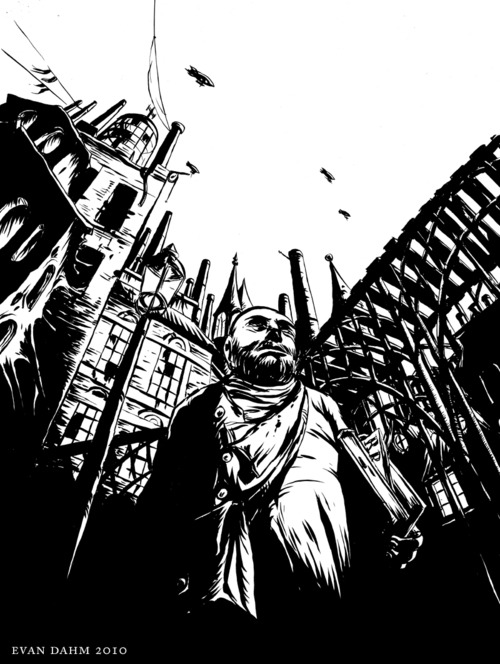
Oh, and here's a great fanart of Isaac dan der Grimnebulin, the fascinatingly flawed protagonist, by an artist posting as Evan Dahm.


Tuesday, October 5, 2010

Haddix' The Shadow Children, et cetera

[This entry contains some partial spoilers for Margaret Peterson Haddix’ Shadow Children series and whatever else I feel like writing about.]

Last night I finished the second of the Margaret Peterson Haddix Shadow Children series. Between them, Among the Hidden and Among the Impostors measure up to the word count and time investment of about one Hunger Games or Percy Jackson novel. Still, they’re good reading, with a believable what-if near-future setting, a sympathetic and complex lead character in Luke Garner, and a structure, so far, of one new person to trust and lose in each book.

Luke Garner is actually pretty likeable. He reminds me the most, recently, of Carl Hiaasen’s lead character in Hoot. The problem with both is that they’re a bit too “everyboy.” Hiaasen’s character – I read Hoot two weeks ago – is already anonymous to me. The story stands out because I like the situations he gets into, and the supporting characters are pretty interesting. Officer Delinko is probably the best developed, and as he started out the Scarecrow of Oz (“If I only had a brain!”), any changes in his character were almost bound to be for the better.

Hiaasen is well known as a talented writer, and I enjoyed the book a lot, but it’s funny how the main character doesn’t actually change much, and only the villain, Dana, and the inept adult character, Officer Delinko, either change or retain their memories in my mind a month after reading. I bet it’s not Hiaasen’s fault – I have a pretty spotty memory. The real point for me, as a wannabe Hiaasen, is that the book was enjoyable, but not especially gripping or moving, and since that is what I want to write, I want to observe the differences.

Let me try a list of them. In the sort of YA adventure/fantasy I enjoy most and want to write,

  • The protagonist is treated with gross unfairness (a la Harry Potter, Katniss Everdeen, or Frodo Baggins).
    The reader shares the protagonist’s emotional commitment to outcomes in the book.
  • The stakes are high – not just social but vital. (This corners me in the adventure-fantasy genre, I suppose).
  • The protagonist experiences increasing setbacks, self-doubt, and danger throughout the book.
  • The protagonist cannot escape his or her circumstances except by confronting the dangers as they mount.
  • The protagonist has a special skill or strength that allows her or him to overcome, but it is not sufficient.
  • The protagonist survives, but loses something important.

Luke Garner is partway toward this ideal. Haddix paints him convincingly into a corner, and then teases us into thinking he’ll get out, only landing him from the mixed-metaphor-proverbial fire. I guess the frying pan was in the corner, or something like that. Whatever the semantics, we follow Lee from bad to worse, to tantalizingly hopeful, to the depths of despair, and a faint but costly glimmer of hope, all in 150 YA (that is to say, short) pages. 

---
I also just read and really enjoyed Jeanne duPrau's City of Ember. It's so calm compared to the Hunger Games, that I almost didn't think I was enjoying it. What a strange feeling! Every page was satisfying to read, and the characters of Lina Mayfleet and Doon Harrow are really sympathetic. Maybe it was just my reading, but I felt so much less tension than when reading these other books. 

There's also the problem of having seen the very good movie adaptation before reading the book. Does anybody else feel this way?

Thursday, September 16, 2010

Tamora Pierce, In the Hands of the Goddess

A couple of weeks ago, I finished In the Hands of the Goddess, the second of Tamora Pierce's vintage (but not tired) tween swords-n-sorcery fantasy series Song of the Lioness. As with the first book, I found world-building and names to be unimaginative, and description inexplicably weighted toward eye and hair color.

Still, the story succeeds on its own terms. Alana continues to learn how to become a knight, and works toward the feared Ordeal that will mark her achievement. That makes a nice structure for the book and for the series. She also has interesting developments with various royalty (all interesting individuals!), rough soldiers twice her size who come to respect her skills, and a goddess.

The outcome of her various concerns is never assured, and the quality of every main character's -um- character is well more than two-dimensional.

As an adult, and a wannabe YA fiction author, I read this with a critical eye for craft, and come away pretty impressed. It's not high art, and it's not as good or original as much else you'll find, but Pierce really nails her character development, and once she gets past the decorative descriptions, they really come alive. I'm especially fond of Sir Miles, whose intentions are opaque to me, but whom Alana trusts at every turn, and of the knight Alex, once squire to her archenemy in this book.

Pierce also does a great job with battle scenes. She doesn't dwell on numbers and formations, but focuses believably and vividly on personal experience, including a very effective rendering of the fog of war. Maybe if you study Medieval crossbow tactics as a hobby, or reenact Hastings every even year, you'd be dissatisfied, but from a general fantasy perspective, this really stands up.

Alana is disguised as Alan for most of the book, and manages to juggle budding romantic interests (I won't say with who) despite this. It's a real balancing act, and the stress of it is worked nicely into the plot.

This doesn't crackle with freshness or originality on many levels, but the series offers a believable and positive female lead, one I would have gladly read about had I ran into this series when I was of the right age.

A few years before Pierce published the first of these, I was reading Anne McCaffrey's Dragonriders of Pern series, to which I compare this. McCaffrey invested more in world-building, which I like, but less in character development than Pierce in this series. Both are very appropriate for tween readers of fantasy.

There is a bit of graphic violence and (socially accepted) teen drinking, though not to excess, in Pierce's series. I know this can be an issue for some parents. I would feel comfortable with my 9 year old son reading this. (He just finished the Eragon trilogy (Paolini), is close to finishing the Amber Spyglass (Pullman) - which has gay angels, and the Hobbit.)