About Me

My photo
A 40-ish publisher (editor, project manager, etc.), husband, and father of an even number of offspring, I grew up, or failed to, reading fantasy and sci-fi. I still enjoy reading, and now am trying to write. My favorite books include YA fantasy, manga, biography, and advice to authors. I'm also a former history major/grad student/high school teacher and assessment writer. Now I work for a school supplement publisher, specializing in high-low chapter books. I spend a lot of my time controlling reading levels. At night, I cut loose and use long words. W00t!
Showing posts with label manga. Show all posts

Wednesday, June 20, 2012

The Jump: Asada Hiroyuki’s TEGAMI BACHI, vols. 3-5


Tegami Bachi, aseries combining elements of off-kilter fantasy and science fiction inlushly-illustrated manga format, took awhile to get off the ground for me. I loved Asada’s heavily-lined, high-contrast, gloomy and angular art, and I was curious about the parceled-out world of Amberground and mystery of the disappearance of a character from the first volume.

The world-building, the suspense and mystery, the art—all of these grabbed me from the beginning, and I didn’t regret buying the volumes, except after the second volume, when I found the narrative wanting.
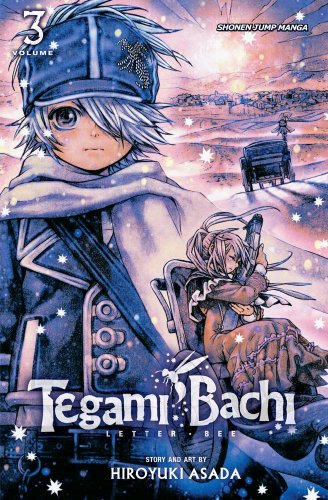
The focus of the series had apparently changed from one character to another, and the reasons why were not clear. However, after a few months, I missed the art, and picked up the third volume. I’m happy I’ve since bought through volume six (and just today ordered the next three).

The story is coming together better. More clues are revealed. The supporting characters are earning their spots in the narrative. We have liftoff.

For a while, the series felt weighed down also by the silly-sounding names. I realized a bit late that there is a pattern, of sorts, and though the names still sound ridiculous (I’ve written about Jiggy Pepper, a minor character, before, but one of the principal characters is named Gauche Suede, and there are more like that), the development of the protagonist and the hints about the disappeared character outweigh that for me now.

This is definite shonen manga material, with a child protagonist, missing parents, speed lines, obscure catch phrases, and very tame “fanservice” shots of a semi-human character who frequently disrobes. Tegami Bachi is published first in Shonen Jump magazine in Japan and the US, and brought out in volumes in Japanese, English, French, and Italian, at least.


Thursday, February 16, 2012

Bakuman vol. 8

I put the seventh volume of Bakuman down around November of last year, and I almost forgot how much I enjoyed it. Fortunately, I've got an Amazon gift card, so I can enjoy the convenience without the guilt of actually sending "Booktopus, Inc." any money.

Author Tsugumi Ohba and illustrator Takeshi Obata teamed up before for the big hit series Death Note, of which I was aware, but not particularly a fan. In this series, they perform an almost postmodern twist, exploring the experiences of a young author-illustrator pair publishing manga in the real-world magazine Shonen Jump, published by real-world publisher Shueisha.

It's fun seeing behind the scenes in the business while enjoying all the stagecraft of manga at the same time. In this case, it's a combination of teen angst, romance, and social drama, with 15-year-old protagonist Moritaka suddenly - unexpectedly even to him - blurting out a marriage proposal to Miho, a girl he's admired from afar for years. Just as unexpectedly, Miho accepts (through her rather grand house's intercom system, no less), but on one condition: they put off even talking in person until they both reach their goals.

Miho is an aspiring seiyuu (voice actress), and possible screen actress, and Moritaka is an aspiring mangaka.

All this takes place in an avalanche of rash decisions that walks a fine line between realistically badly thought out teenage planning and crazy fantasy.

Moritaka's writing partner is Takagi, a wise-cracking high-achiever who's really tired of being admired for getting good grades. He gets the ball rolling at the beginning of the series - by suggesting he and Moritaka team up blackmailing Moritaka into teaming up with him in the first place, and then that they go talk to Miho about their plans - and provides plenty of impetus to the plot in each volume.

As of volume 8, Takagi's girlfriend Kaya (who goes casually by her first name Miyoshi most of the time) is my favorite character. She doesn't get as much "screen time" as the other leads, but in compensation, packs a punch, often literally. Kaya is fiercely loyal, emotionally mercurial, considered tomboyish and not pretty (hard to tell in the drawings, which make her look tomboyish, voluptuous, and cute all at once), but she proves to be not only the glue holding together the friendships of some of the leads, but also a catalyst in expanding the circle of friends in unlikely ways.

I got the delivery a couple of days ago, and read the whole thing last night. I waited so long to order it, volume 9 was ready, too, so I have something more to read this weekend.

Tuesday, July 26, 2011

Distracted...

This is hard to explain, but I recently read a book, and wanted to write about it, but forgot what it is.

My current reading list is:
1. Gennifer Choldenko, Al Capone Does My Shirts (reading aloud with the boys), soon to be followed by Al Capone Shines My Shoes; I look forward to reading these every night!
2. Kim Stanley Robinson, Fifty Degrees Below (bathroom reading...Robinson's novels are kind of filling, so I read the climate change-aka Science in the Capital-series a little at a time); Frank Vanderwal is finally growing on me, a bit
3. Lev Grossman, The Magicians (this is good enough to make me skip manga for days at a time)
4. various high-interest, low reading level books I'm reviewing and/or revising at work
5. political blogs that I haven't felt compelled to comment on
6. various manga

My non-reading demands are also high. The kids are in a sports day camp that cuts into my workday, I have lots of stuff due nownownow at work, and I've been getting more exercise lately.

I'll be interested to rediscover what it is I just read, and then think about whether it's worth sharing if I've forgotten it that easily.

Monday, June 6, 2011

MORI Kaoru's Bride's Story (manga)

I love this book. I read unlicensed scanlations of it online, and considered buying Mori's earlier series, Emma, just to support her, even though the story didn't captivate me.

So I was thrilled when Yen Press came out with a (hardbound!) collection of the beginning of the story, and immediately bought vol. 1. I can't wait for vol. 2.

What makes this so captivating? First it's the art. Mori draws in a shojo (think: really big eyes) style, but way off to the extreme of detail and style. There's none of the sparkly silliness, the super-deformed comedic moments, the school-uniforms-and-cherry-blossoms sameness of her art, or her subject.

Bride's Story is set around the Caspian Sea in the 19th century, with Russia and England pursuing their "Great Game" in the area, which impinges on the story subtly at first. Mori draws scenery like an Italian Renaissance painter, with details of hills stretching out to the horizon. I've never been to the Caspian Sea region, but now I want to go.

She also paid exquisite attention to details of costume, architecture, and material culture. Even were she to have gotten the details wrong, you can't help on reading this to admire the wealth of detail. I'm inclined to think she got it right, at least mainly, because of the elements that ring true to me, but I really don't know.

The story is full of challenges, difficulty, and warmth - even romance. (Yes, it's really a shojo manga!) But it's also full of action (at first, and often, provided by the bride of the title), which makes it look and read more like a shonen manga, for boys. But at its heart it's far more serious. It's really a grown-ups' story, or at least YA. The action and themes are mature, including the marriage in question (what's shocking to readers is the youth of the husband; what's shocking to people in the story is the age of the bride), and the relations between different groups of nomads and townspeople.

I've read through chapter 10 of the scanlation (which I am now avoiding because it's licensed in the US), and will definitely invest in the remainder of the series.

Thursday, March 3, 2011

just received: Revis, Across the Universe; Mihara, The Embalmer vol. 2

Mail-order book addict confession: I like bookstores. I never have the time to go to them, or almost never. I also like reading. A lot. So I order online. Probably too often.

I was happy this morning to collect my new books from the shipping dept. at work. I read the first chapter of Beth Revis' Across the Universe (sci-fi, romance, suspense, who knows what else?) last fall on a promo site, and felt the same electric tension (with more wrenching of viscera) as in Collins' Hunger Games novels. That is to say, a heckuva lot. It will be a struggle to put off reading this till I've whittled down the rest of my reading list.

Also in this shipment, a book I've already read, but for free, illicitly, online. I decided I wanted to own The Embalmer, which Tokyopop publishes in the US, and was having trouble getting vol. 2 from the publisher, so I ordered a used copy. There's a small dent in the cover, but it's otherwise fine. Mihara tells a somewhat unusual story about a pretty darned unusual character, since most Japanese are cremated instead of being buried in caskets. The art and some tropes are typical of seinen manga - the market segment of men over 20 or so. What I read before made me feel like committing to this series. Good thing most seinen manga have short runs. (The top selling shounen (boys') manga, like One Piece and Naruto, run above 200 chapters, that's dozens of $10+ volumes.)

Wednesday, September 8, 2010

Found in Translation: Soccer and Basketball Manga

Phew! Brief hiatus, in which I read another Tamora Pierce book (comments TK) and attended a Scottish cutural festival without drinking any ale.

For today, I just read Jonathan Bethune's Found in Translation: Soccer and Basketball Manga, where I left the following, incriminating comment:
I didn't know Captain Tsubasa had such a long history. I agree - the eight year run sounds like a good addition to manga libraries.

For my part, the sports series I would love to see licensed and translated in the US is Urasawa Naoki's tennis drama, "Happy!" The main character Umino Miyuki's grit, shown wonderfully in her facial expressions and body language, and her frustrating stoicism both make for a great combination of sports and drama.

It's definitely a seinen manga, but there's a romantic theme that probably cut into the purity of its fan base in Japan where, I read, it suffered by comparison with Urasawa's immediately preceding sports series, "Yawara."

Umino's name, Miyuki, which means "happy," gives the series its somewhat overbearing irony, in that (as far as I've gotten with the amateur translations), she isn't.

If I win the lottery, I'm going to have somebody translate this for me. It's that good.
I'd welcome more sports manga that looked and read different from "Eyeshield 21," which has a silly name and a skimpy premise, with underdeveloped characters, little story line, and spazzy art, or "Beach Stars," which is cheesecake volleyball (hmm, the word "skimpy" applies here, too), and exploitative of short people! (I'm tall, but I still disapprove...maybe not enough to keep from looking, but still I disapprove.)

Tuesday, August 24, 2010

online manga going legit?

I read manga. A lot of it, actually. I recently started buying it again because I was looking at so much free online manga. The group of publishers who organized to stop free distribution of manga have it right. I'm hooked - now it's time to start charging me for content. (Before the web, I collected manga. I have boxes in the garage. Maybe I should sell...)

I hope they'll start paying creators better in the same move.

Manga creators and fans may get an interesting break from the publishers' stranglehold, though. In After Scanlations: Manga Publishers Look to Offer Legal Digital Access, Kai-Ming Cha tells about several publishers' (Yen, Viz) and distributors' (Crunchyroll) plans to offer paid access online.

This is where the publishers have it wrong, I think. Yen's "Yen Plus" will only offer Yen titles. Viz will offer the much more appealing (to me) catalog of Viz titles.

Would you pay a fee to a music label for access online to its signed artists' work?

That's why I think the iTunes model (I've been going on about this for awhile) - which I'm encouraged to read Crunchyroll (currently distributing eons of anime content for low to no fees) is building a manga reader. They're not publishers, so they just license the content they think will work and for which they can get the rights.

Best of luck to 'em.

By the way, since computer screens are landscape, and manga pages mostly portrait, will the reader be capable of rendering the page legibly in the space available?