About Me

My photo
A 40-ish publisher (editor, project manager, etc.), husband, and father of an even number of offspring, I grew up, or failed to, reading fantasy and sci-fi. I still enjoy reading, and now am trying to write. My favorite books include YA fantasy, manga, biography, and advice to authors. I'm also a former history major/grad student/high school teacher and assessment writer. Now I work for a school supplement publisher, specializing in high-low chapter books. I spend a lot of my time controlling reading levels. At night, I cut loose and use long words. W00t!
Showing posts with label books for girls. Show all posts

Wednesday, August 29, 2012

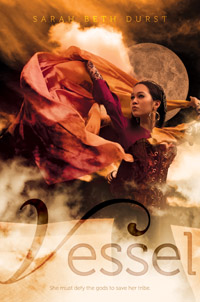
preview, VESSEL, by Sarah Beth Durst

I got sidetracked at work and followed a link to the sample chapters of a new fantasy novel, Vessel, by Sarah Beth Durst.


The book is due next month from Simon & Schuster, which continues to impress me with the quality and quantity of their YA offerings.

The premise is compelling: What if you prepared your whole life to become a sacrifice to a goddess that would save your people, and then the goddess did not accept your sacrifice?

The sample reads very well. The pace is great, and the descriptions draw a solid world, full of textures, smells, sounds, and characters. I have small quibbles with the dialogue and the use of alliteration. Small quibbles indeed.

The protagonist is a girl, about 16 years old, and I think the crossover appeal to boys would be less than for The Hunger Games, but it's still possible. Then again, I'm not a teenage boy, so I don't mind. 

The invitation that drew me in includes high praise from Tamora Pearce. If you're a fan of hers, as I am, this will certainly appeal.

Oh, and nice cover design.

Wednesday, August 1, 2012

Where, indeed: Barry Deutsch's HEREVILLE: How Mirka Got Her Sword

Years ago now, I read a hefty online sample of Barry Deutsch's more-than-charming graphic novel Hereville: How Mirka Got Her Sword. I call it "more than charming" because it was both a fairy-tale-ish story told in drawings that, despite the muppetlike heads, seemed so obviously perfect for it, and at the same time a rich treatment of humanity.

Find out more from Deutch's website, Hereville. 

I don't put it that way to make it seem grandiose, but the universality of the story, told from the perspective of a little slip of a girl in a tiny town that was part of an often-overlooked corner of a small minority in a big, pushy world, is hard to deny. Deutsch has created such a perfect character in Mirka that, although she is culturally atypical, and kind of an odd kid within her culture, a reader as unlike her as myself has no trouble sympathizing.

Mirka has a strict stepmother, a distant father, a nosy little brother, bullies and monsters to avoid, and a few things that she loves without restraint, an immediate kind of nostalgia that I think only children can feel. Certain things, often small or outwardly insignificant, are indispensable to kids, around the time that they become aware of the potential for change. Having lost her mother, Mirka treasures the familiar, and even though her lodestones are different from mine, they feel as true and real in the story as my own did (at least in nostalgic perspective).

Recently, I stumbled across the full book at the library, and snapped it up. My kids (11 and just-turned-8) tore through it and declared it was good. I snuck in two reads, with mounting satisfaction.

And what do I learn today? Happily, that there will soon be a second Hereville. Perfect.


Saturday, May 12, 2012

return to a theme - Pretties by Scott Westerfeld

Close on the heels of Wintergirls, I read Scott Westerfeld's Pretties, the second in his series that eerily twists a major theme from Wintergirls around a strong sci-fi premise, and all too literally shapes the characters to fit the scene. There's a one-two punch going on here: Westerfeld created a compelling world for his characters to live in, and characters who stand a good chance to survive and even change it.


In many ways, I thought Pretties outshone the first in the tetralogy, Uglies. The first book in a science-fiction or fantasy series always has the advantage of the reader's wide-eyed wonder. Janet Rowling dithered on her way to introducing the main character, and it worked, because the wizarding world was so fun to watch, especially how an awful muggle like Uncle Vernon interacted with it. JRR Tolkien shows us the placid Shire and introduces the simple hobbits, and simpler dwarves, long before moving on to a plot. And Westerfeld's alt-future world is compelling, but his writing in the second book feels stronger.

One of the fun developments is the protagonist Tally's increasingly complicated relationships, with her friends, her allies, and her society's authorities. Part of the complication is due to the rules of the society Westerfeld set up, in which a central authority tinkers with perception and memory. When this point is abstracted, the premise sounds almost like a postmodern sociology text, but it works well as a plot element. It's also reminiscent of Philip K. Dick, though much friendlier and more action-packed. Dick's characters spent more time in a fog of self-delusion, or believing they were deluded, or not knowing something basic like if they were human, whereas Westerfeld's fly around on hoverboards and have major, dramatic confrontations.

Still, the themes of body image, friendship, and betrayal will resonate with teen readers today. He's cleverly worked the familiar into the strange, and halfway through, this feels like a series I'll continue to enjoy.

Sunday, February 5, 2012

Unfair!


Nothing says I have to be fair, however, or that either author would benefit. 

** Note: some spoilers below

Pictures of Hollis Woods is a literary novel for tweens. I’m not sure I’ve encountered anything like it till now. Sure, we’ve all read and/or avoided the sorry-for-the-poor-kid books that read like Saturday afternoon tv specials from the 19

70s. They give me a headache, probably caused by trying to digest the frosting cliché on the middling cake of a story.

And Hollis Woods, the protagonist, is the kid from those stories. She’s an orphan, difficult, twelve, vulnerable and hard at the same time, and oh, so deserving of a better life. However, that’s not how the story reads. Here’s why I think Giff’s book is a literary novel: structure.

The title means something (there’s a concept) – in this case, it’s a device for flashbacks, delicately revealing how Hollis’s past becomes her present, and Hollis’s own contribution to her story, the scenes of her life she draws to remember, someday perhaps to understand, as well as a way she can be herself while drawing, something she yearns to do, and does with remarkable skill and vision.

The current chapters all have the same title, indicating the present day, and the flashback chapters all are about the subject of a drawing, narrating the time leading into, and after, the events Hollis depicts. Giff executes this subtly and cleverly, rendering the flashback narratives in italics, and revealing just enough to keep the story flowing toward its goal.

The end isn’t a huge surprise. It’s not supposed to be. Of course Hollis finds a family. Of course it’s the Regans. Of course Josie is part of her life. None of this is in question after page 40 or so. It’s not a mystery, but a narrative of strands weaving together just as people’s lives intertwine.

This is a delicate slip of a novel, under 170 wide-lined pages, and all fitting together neatly. The characters all matter, are all recognizeable, all memorable. It’s about the easiest thing in the world to read, vocabulary aside (and that’s not too hard). If I taught sixth grade, I might assign it to the class.

So, what’s so bad about Tim Green’s Rivals? It can’t be “unfair” to compare it to a Newberry Honor Book like Pictures of Hollis Woods without being unfair to Rivals, can it?
 
Why, yes, it can.

Green’s a master of a different type of storytelling. There are few flashbacks. There’s no fancy structure. It’s great for baseball-crazy boys, and perhaps a few girls who don’t mind that baseball stories always focus on the boys. (There’s a strong girl character in here – hoo, boy, just wait.)

And Rivals is all about twelve-year-olds, too. These kids are doing pretty well for themselves. Josh LeBlanc is a baseball prodigy, six feet tall a bit early, and a skilled batter and infielder. He makes all the plays you want to see (if you like baseball, which I don’t , but which I started to, a little, on reading this). Josh is also gifted with insight, a great coach who is also a great father, and two awesome friends – Benji, whose over-the-top self-glorifying banter is never meant nor ever received as pridefulness, and Jaden, whose feelings for Josh lurk dangerously close to the surface of their friendship, without her or Josh ever really figuring it out.

Here’s the thing: Green’s characters all matter, are all recognizeable, all memorable. Green drives the plot relentlessly forward, which takes less concentration on the part of the reader, but with twice the pagecount, there’s a lot more story. It’s rollicking good fun, with danger, adolescent angst, athletic challenges, and clever dialog. It crackles with the intensity any successful novel for tweens has to have. But reading it is not like solving a puzzle. It’s like riding a roller-coaster.

So, what’s fair or not? In truth, I’m glad I read both books. If I liked only boyish books like Rivals, would I be open to reading Pictures of Hollis Woods? And if I favored the contemplative, sparse narratives of Patricia Reilly Giff, would I be open to enjoying the driving linear narrative of Tim Green? I hope so. The unfairness comes in part from the channeling we experience, our tribalism infecting (or shaping? I guess it matters which word I choose, and I’m not sure about my choice) everything we do or think. Even with all the clever ways these authors break boundaries, by including characters, meaningfull ones, of various tribes, in their narratives, we still read the book in a genre or demographic category.

My older son is in sixth grade. I imagine a classroom like his somewhere, where a boy reads Rivals next to a girl reading Pictures of Hollis Woods. I hope they talk with each other when they’re done.

Friday, September 9, 2011

Ambiguity, not ambivalence: Fall of a Kingdom (Farsala series), by Hilari Bell

Book Review: Fall of a Kingdom (initially released as Flame), by Hilari Bell
(Farsala series, book 1)

From the opening hint of mythology, through the interwoven tales of characters drawing together in the narrative fabric, to the devastating end and the protagonists’ reactions, Fall of a Kingdom resists easy judgments and moral alignment. While reading, I was impressed with Hilari Bell’s careful balancing of three main characters’ narratives, both against each other and together against the incrementally constructed mytho-historical background of the book’s events.

(In a nice twist, Bell uses a real mythology to explain the fictional characters’ story.)

Bell names the chapters after the protagonist whose narrative point of view is represented in it. I recently read two novels set in space that did something similar; Bell’s version of this is the more natural feeling, why I can’t figure. (Please leave a comment if you can help me figure this out; the other two were Beth Revis' Across the Universe and Amy Kathleen Ryan's Glow.)

Two of the three protagonists – the male ones – begin as sympathetic characters; the female protagonist, Soraya, is introduced in a male character’s chapter, but soon thereafter has her own internal monologues and is shows equally appealing characteristics. This begins the complications of judging Bell’s characters, as an appealing protagonist develops faults, and a faulty one strengths.

This was the aspect of the story that most struck me after reading Fall of a Kingdom. (That, and the small matter that the library copy I read had the initial release title, Flame, making it the second book I’d read in a few weeks that had a title I couldn’t justify on its relationship to the story.) Not only did the characters interact, often without knowing, and not only did they seem to be converging on a conflict shrouded in myth, but I was sure I wanted each to prevail against the others, or better, to somehow betray their essential differences and join forces against…what?

However simplistic Bell’s world creation may prove, Farsala is a land without persistent bogeymen. Kavi hates the deghans (nobles) for their exploitation and disregard for the lives commoners, but deghass (noblewoman ) Soraya develops conscience and consideration through her hardships, and more particularly through her encounter with the desert-dwelling Suud; Soraya nurses a resentment against her peasant-born half-brother Jiaan, whose noble father (he’s Soraya’s as well – nobility passes from mothers to children) elevated him above many of the high-born; Jiaan resents the deghans he serves, but develops a modicum of respect for some of their eccentricities, while distancing himself in distaste from the peasants out of whose milieu he rose; and so the conflicts thicken.

Many of the secondary characters also appear Janus-faced in this manner, including the commander of an invading army, a child pickpocket, and a deghan who shows common sense. I look forward to meeting these six and many new characters in the sequels.

Fall of a Kingdom is a book “for young readers,” printed something like 12-on-20 points (almost double-spaced), and written without frivolous violence or “provocative moral situations.” There is the slightly uncomfortable sense that a romance may develop between half-siblings Soraya and Jiaan, but that’s an element of many myths, from Izanami-no-Izanagi, a Japanese origin myth, to Star Wars. I think any kid in the double digits who likes adventure, magic, intrigue, and battles in good balance would like Fall of a Kingdom.

Saturday, April 30, 2011

The Boy on a Black Horse, by Nancy Springer

I'm editing books on horses, targeted for teen girls. Actually, I fought for the series, came up with the characters, the setting, and most of the plot outlines, found an artist, leveled the manuscripts, and I am now supervising the artist I selected while finishing the editing process and commissioning the cover design.

The problem is - well, problems are - I'm not a teenage girl, and I don't like horses.

I rode one once, for maybe half an hour. Then I was in a hospital for a few days. That was over three decades ago, and even with Facebook, I don't recognize most of the people I went to grade school with. They post these nice pictures, and I think, "who's that?" with almost every name and face.

The horse's name - the one that threw me: Brandy. Yes. I can remember that.

So I'm not a devotee of the genre, it may safely be said. I thought it might be good to check if we were doing it right, and last week I finally checked out a somewhat dated book by a fairly prolific author of girls' fantasy books, mainly with horses, and dove in.

It was great! Springer is one of those authors who, like Suzanne Collins, believes in grabbing the viscera in the opening lines. Nothing, for me, starts off like The Hunger Games. But Springer's The Boy on a Black Horse starts with that same, simmering power, the feeling of loss, and promise of danger.

The first time I ever saw him I was pretending to write in my daily journal in language arts class but actually drawing a horse--the head and neck had come out run-in-the-wind gorgeous, but I knew I would never get the rest of it as good--and when the door opened I looked up like everybody else, and there was a strange boy walking into my life. 

Every part of that opening works. There's suspense, questioning, romance, mystery, characterization... I can see where, over the next few paragraphs, Collins has done Springer one better, by showing the near ends of all the final threads immediately, and quickly turning dread into relief into panic. This doesn't progress like that, but instead quietly, calmly introduces Gray Calderone's motivations and history, about at the pace a real person might on meeting someone new, and coming to trust them.

Anyway, the purpose of reading this book was not to enjoy it, though I really did. It was to check on Copper Canyon, my series of short books for struggling older readers. (I say "my" - I'm not the author, and Deb did a great job, but for the purposes of writing a high interest-low reading level book, I have to take out every word or phrase and replace it with another. I call it "fossilization." Not the most promising verb, but a good metaphor for the process.) I am pleased as much by the comparison as by the research. Now I get to go back to the editing, and not worry whether the books will be enjoyable. (There's plenty else to worry about in publishing, anyway!)

Tuesday, November 2, 2010

denouement: Eva Ibbotson, Journey to the River Sea

Eva Ibbotson's Journey to the River Sea is the model of a good middle-grade adventure. There's a sympathetic lead character (plucky, troubled, different, kind, resourceful...), a patient, powerful, and wise adult, a few adventurous (eventually) cohorts, and some really petty villains. There's great scenery, the potential for small dangers, and real betrayal.

You could read the book if you were uptight, and never have your buttons pushed. (Well, maybe if you're really, really uptight. I hope not.) And it wasn't boring, slow, or shallow at all. That's a really nice trick.

The cover of the volume I have is like all the other Eva Ibbotson book covers I've seen - a bit soft and impressionistic, somewhat feminine. Clearly the covers are aimed at girls. But the story would be enjoyable by boys a little past the Beverly Cleary level of adventure, and maybe to more adventurous ones as well. Journey to the River Sea is set in a realistic, Victorian past, with scenes in England, on the Atlantic, and mostly in Brazil. The landscapes, riverscapes, and social situations are detailed without being overwhelming or tedious. The plot chugs along reliably like a small riverboat, with sudden turns and eddies that end up changing everything.

I think I'll send a copy to my niece, who's in third grade.

Eva Ibbotson, born in 1925, passed away in October of this year, leaving at least a dozen books for us to enjoy. Start as I did with Journey to the River Sea, and I think you'll follow me to the rest of her works not long after.

Read about a few of her books published by Penguin. 

Monday, August 23, 2010

Alanna (Song of the Lioness, book 1)

by Tamora Pierce

I read stuff written for kids. Well, teenagers. I find a lot of it more satisfying and worth my effort than littratoor written for adults. I not only slum around in genre fiction, I choose what's published for people less than half my age.

Tamora Pierce's name leapt out at me from the teen fiction shelf at the library Saturday. I'm a regular because my house doesn't have any good spots for tutoring, and as much as I like my students, I don't want them sitting on folding chairs next to my slumping, half-full rice sacks.

My own kids were busy using the computers to play a mind-numbing dragon-fighting game the library staff have given up on banning, so I had a few minutes, and found a fun read.

Cons before pros:

Ms. Pierce does not waste her writing talent on creating interesting names - not for her characters, nor places, nor objects, nor the books themselves (though agents and publishers may have had more of a hand in enforcing the dull verbiage squatting on the cover of this book). That said, there is considerable storytelling talent inside.

Alanna: The First Adventure is the opening salvo of four novels. My guess is they're adventures. And feature Alanna. Really - are there no more interesting things to call the book?

Too little other than hair and eye color is disclosed about characters when they are introduced.

Oh, and there were three typos.

The Pros:

This was a fun, fast read, with well-defined and interesting characters doing things that mostly mattered. Pierce put in a lot of plot twists that, while not shocking, kept my attention, and didn't fall into too much of a pattern.

Yes, it's a story about a plucky girl, magic, sword-play, thieves, horses, ruins, knights, and cross-dressing, and who hasn't read a dozen of those this past year, but at least there are no vampires!

The pacing is just about right for an upper elementary to middle school reader, and the words and situations are suitable for anyone whose parents got over what's in the Harry Potter series.

All in all, a bit formulaic, but successful anyway because the author had a clear idea of her characters and their stories.

An admission:

I might not have borrowed and read this book if it hadn't been about twelve year old fraternal twins who get separated and have adventures. That's about the extent of the commonality between this book and what I'm writing (if you can call 300 words a day writing), but it was enough to snag me. It might not mean the same to you, but if you have a ten to thirteen year old girl (or boy - Alanna's a good character for both) in your life who is looking for an adventurous read, and who hasn't said she (or he) was sick of fantasy, this is a promising start to the series.