About Me

My photo
A 40-ish publisher (editor, project manager, etc.), husband, and father of an even number of offspring, I grew up, or failed to, reading fantasy and sci-fi. I still enjoy reading, and now am trying to write. My favorite books include YA fantasy, manga, biography, and advice to authors. I'm also a former history major/grad student/high school teacher and assessment writer. Now I work for a school supplement publisher, specializing in high-low chapter books. I spend a lot of my time controlling reading levels. At night, I cut loose and use long words. W00t!
Showing posts with label science. Show all posts

Tuesday, September 20, 2011

Erik Asphaug's two moons hypothesis, the coolest thing I read today

This is way cool. A UC-Santa Cruz Earth and Planetary Sciences professor and his grad student created a computer model to explain the mountains on the far side of the moon. 


The model involves a second moon around the earth, back when earth was very new and still mostly molten. The collision that created the moon may well have created a second one, and as the moon receded from the earth, it may have come into the orbit of the smaller moon. A slow collision would have spread the material of the smaller moon around one hemisphere of the larger body, creating the mountain ranges on the far side, and possibly triggering the orbital "lock" that keeps the older side of the moon facing earth.

Astrophysics is really, really cool.

Thursday, July 28, 2011

coolest thing I read today: "A New Era for Scientists and Engineers"

Found on Facebook...

I read Steve Blank's announcement/contextualization of the National Science Foundation's Innovation Corps, a plan to make business development native to science and engineering entrepreneurs, not to imbue traditional business thinking in them, but to recast the challenges of business as a kind of experiment.

Blank says it better than I do, and links lots of things together, so you can follow the threads of his thoughts at will until everything starts to come together.

The first piece I read from him was about the history of business in Silicon Valley, "How Scientists and Engineers got it right, and VC's got it wrong." I found it informative and enjoyable, despite the misuse of an apostrophe. I won't let my small ideas intrude on his big ideas.

Monday, July 11, 2011

coolest thing I read today: telomeres!

But you can't read it, unless you get the Chronicle on your iPad or on shredded trees. Or wait till Wednesday at 3pm for this link to work.

I wasn't a science guy in college, but I'm not sure why not. (Hint: math.)

This is pretty cool, though. The ends of chromosomes fray with cell reproduction and stress, and when they're gone, you die. (Yikes!)

It's as if the non-coding ends of chromosomes were the fraying fringes of carpets. They absorb the damage and stress of pounding feet, and yet the carpets remain whole, until the fringes are breached.

See why I wasn't a science guy? Still, cool stuff.

More about telomeres here:
Wikipedia
Kimball's Biology Pages
Science Daily

Thursday, June 16, 2011

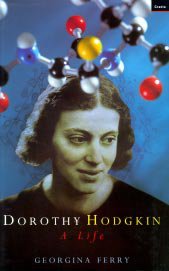
Dorothy Hodgkin: a life, by Georgina Ferry

Dorothy Crowfoot Hodgkin seems like the kind of person who merits duelling biographers, Every page of Ferry's dully titled, well-ordered, and crisply phrased seemed packed with Hodgkin's own energy. From a young age, Dorothy Hodgkin, born Crowfoot, seems to have been working at an accelerated rate, driven by curiosity and enabled by intellect and good fortune (her encouraging and liberal family, her family's fortuitous financial circumstances, the contacts and possibilities presented to her), she left her biographer the happy task of way too much to write about at once.

I felt at times an unhappy comparison with my own accomplishments, or more precisely, with my own drive.

Hodgkin (1910-1994) is principally famous for mapping the structure and composition of a few major organic molecules, especially penicillin, vitamin B12, and human insulin. She did this through a field of physical chemistry I had not understood at all prior to reading Ferry's account, x-ray crystallography.

The process involves triggering crystal formation in the target molecule (I really have no sense how this is done), isolating crystals of it, firing x-rays through the crystals, and catching the refractions on photographic paper. The crystal is turned a number of times and new refractions captured. Careful analysis of the patterns leads to testable hypotheses in some cases, and with numerous follow-ups, even complex molecules can be mapped - not only the composition understood, but the locations of atoms, and even arrangements of electrons. Considering the finesse of the task, or the stark differences proceeding from small chemical changes, this is quite a difficult and a useful endeavor.

Hodgkin was also notably a magnet, a catalyst, a principal cause. She should be equally famous for her ability to charm and convince people to give her, and other scientists, often women or non-Europeans, opportunities. She broke (and trampled to dust) several barriers, or stormed the walls with the first wave (she was the third woman inducted into the Royal Society). Once established, she made her laboratory a site of cross-pollenization, a platform for unattached scientists, and the development of new ideas. Her own work and the work she inspired, supported, and often (later) funded, opened up fields of inquiry.

This brings me to my motivation in reading this dense and informative decade-old biography. I was trying, and I failed, to find the source of a quotation I'm probably misremembering. It may go like this,
The value of a good bit of work is that it inspires imitation, and is soon eclipsed.
To me, that encapsulates quite well the attitude of the Nobel Laureate Hodgkin. I began to be interested in her story principally to check this quotation. Having now, finally, finished reading the book, I can't say I'm much closer.

However, I have enjoyed reading what feels like intellectual history raiding the land of biography.