It's raining.
Herman Cain is the Republican favorite.
Steve Jobs is dead.
What am I complaining about? (Warning: I am about to complain.)
I am complaining about a missing "e" in a comic.
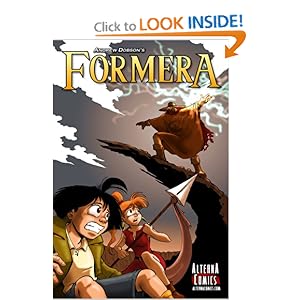
I followed a link from deviantart to the amazon page for a comicker I didn't know - Andrew Dobson. His new series Formera has two volumes out, and in the first, the "look inside" sample has a misspelling on the third page included. (It's probably page 2, but I can't tell if the first is a title page, the cover, or page 1).
The error? Boy falls from sky into water. Reaction? "I can't breath!"
Come on. There are twenty words to a page in this comic. Six editors had to have looked at that. The text editor for blogger (TM) highlights misspelled words!
Fer cryin' out loud!
About Me
- Steve Shea
- A 40-ish publisher (editor, project manager, etc.), husband, and father of an even number of offspring, I grew up, or failed to, reading fantasy and sci-fi. I still enjoy reading, and now am trying to write. My favorite books include YA fantasy, manga, biography, and advice to authors. I'm also a former history major/grad student/high school teacher and assessment writer. Now I work for a school supplement publisher, specializing in high-low chapter books. I spend a lot of my time controlling reading levels. At night, I cut loose and use long words. W00t!
Thursday, October 6, 2011
Monday, October 3, 2011
a "makers versus takers" type email
I was distressed that a friend forwarded this email:
And I had this response:
People who do not pay income taxes (because they have little or no income) pay sales taxes. Many of them get “free stuff” in the form of temporary aid. Some of them get “free stuff” in the form of temporary aid that lasts a long time. This is a problem because they are consuming and not producing.
People who do not pay income taxes (because they have a lot of money, and spend a small portion of it to shield a greater portion from taxation) pay sales taxes. many of them get “free stuff” in the form of access to roads and bridges, fire and police protection, clean water, hurricane warnings and the like. This is a problem because the system that everyone else pays for allows them to benefit enormously without contributing to the system.
People who do pay income taxes make up the majority of Americans. They also pay sales taxes. Their tax payments educate the vast majority of the future doctors, engineers, and construction workers – of all of us. Their tax payments allow governments to build and maintain roads and bridges, test cantaloupes for dangerous bacteria, and inspect cost-cutting/profit-maximizing airlines’ planes before takeoff. They also own the airwaves that the government they pay for licenses to broadcasters. This is good because the people who pay the taxes by law make the decisions, however indirectly, in government.
This is where it gets interesting. The people who don’t pay income taxes (because they have enough money to shield their money) own a lot of broadcast media. They do it as individuals, as corporations, and as interest groups. They are a bit scared of the people who do pay most of the income taxes. They have a choice: fight us (hard) or co-opt us (not quite as hard). They have tools for fighting (bloody) and tools for co-option (less bloody).
I’m glad they chose the easier, less bloody route of telling you what to think. Now I am still alive to tell you what I think. I think they are filling your head with misinformation.
If there’s a class war, who won? The people who are out of work and hopeless and still sitting on their hands, or the people who are comfortable and well-fed and in control of media and government? Or, to use the original writer’s metaphor, the wealthiest are the wolves.
I have to get back to work if I’m going to continue supporting public education (my kids are in school right now), the interstate highway system (how I get to work and how my food gets to the grocery store), the public utilities commission (which helps keep electricity rates down so my boss can keep the lights on), et cetera, ad nauseam.
Stay well,
Steve
---
I think I was very diplomatic. Now I really have to get back to work!
Subject: FW: FREE STUFF....
Worth reading.
>
>
> I have never heard this said as plain or as well.
>
> Class war at its best.
>
> The folks who are getting the free stuff, don't like the folks who are
> paying for the free stuff, because the folks who are paying for the free
> stuff, can no longer afford to pay for both the free stuff and their own
> stuff.
>
>
>
> And,
>
>
>
> The folks who are paying for the free stuff, want the free stuff to stop and
> the folks who are getting the free stuff,
>
> want even more free stuff on top of the free stuff they are already getting.
>
>
>
> Now... The people who are forcing the people who Pay for the free stuff,
> have told the people who are RECEIVING the free stuff, that the people who
> are PAYING for the free stuff, are being mean, prejudiced, and racist.
>
>
>
> So, the people who are GETTING the free stuff, have been convinced they need
> to hate the people who are paying for the free stuff, by the people who are
> forcing some people to pay for their free stuff, and giving them the free
> stuff in the first place.
>
>
>
> We have let the free stuff giving go on for so long that there are now more
> people getting free stuff than paying for the free stuff.
>
>
>
> Now understand this. All great democracies have committed financial suicide
> somewhere between 200 and 250 years after being founded. The reason? The
> voters figured out they could vote themselves money from the treasury by
> electing people who promised to give them money from the treasury in
> exchange for electing them.
>
>
>
> The United States officially became a Republic in 1776, 231 years ago. The
> number of people now getting free stuff outnumbers the people paying for the
> free stuff. We have one chance to change that in 2012. Failure to change
> that spells the end of the United States as we know it.
>
>
>
> ELECTION 2012 IS COMING
>
> A Nation of Sheep Breeds a Government of Wolves.
>
> I'M 100% for PASSING THIS ON.
>
> Let's Take a Stand.
>
>
>
>
> Obama: Gone.
>
> Borders: Closed.
>
> Language: English only.
>
> Culture: Constitution, and the Bill of Rights.
>
> Drug Free: Mandatory Drug Screening before Welfare.
>
> NO freebies to: Non-Citizens.
>
> We the people are coming....
>
>
> Only 86% will send this on. Should be 100%. What will you do?
>
And I had this response:
People who do not pay income taxes (because they have little or no income) pay sales taxes. Many of them get “free stuff” in the form of temporary aid. Some of them get “free stuff” in the form of temporary aid that lasts a long time. This is a problem because they are consuming and not producing.
People who do not pay income taxes (because they have a lot of money, and spend a small portion of it to shield a greater portion from taxation) pay sales taxes. many of them get “free stuff” in the form of access to roads and bridges, fire and police protection, clean water, hurricane warnings and the like. This is a problem because the system that everyone else pays for allows them to benefit enormously without contributing to the system.
People who do pay income taxes make up the majority of Americans. They also pay sales taxes. Their tax payments educate the vast majority of the future doctors, engineers, and construction workers – of all of us. Their tax payments allow governments to build and maintain roads and bridges, test cantaloupes for dangerous bacteria, and inspect cost-cutting/profit-maximizing airlines’ planes before takeoff. They also own the airwaves that the government they pay for licenses to broadcasters. This is good because the people who pay the taxes by law make the decisions, however indirectly, in government.
This is where it gets interesting. The people who don’t pay income taxes (because they have enough money to shield their money) own a lot of broadcast media. They do it as individuals, as corporations, and as interest groups. They are a bit scared of the people who do pay most of the income taxes. They have a choice: fight us (hard) or co-opt us (not quite as hard). They have tools for fighting (bloody) and tools for co-option (less bloody).
I’m glad they chose the easier, less bloody route of telling you what to think. Now I am still alive to tell you what I think. I think they are filling your head with misinformation.
If there’s a class war, who won? The people who are out of work and hopeless and still sitting on their hands, or the people who are comfortable and well-fed and in control of media and government? Or, to use the original writer’s metaphor, the wealthiest are the wolves.
I have to get back to work if I’m going to continue supporting public education (my kids are in school right now), the interstate highway system (how I get to work and how my food gets to the grocery store), the public utilities commission (which helps keep electricity rates down so my boss can keep the lights on), et cetera, ad nauseam.
Stay well,
Steve
---
I think I was very diplomatic. Now I really have to get back to work!
Tuesday, September 27, 2011
Origin of "Humpty-Dumpty" - the coolest thing I read today
In a book packager's newsletter, the origins of "dead metaphors" was the topic today. Specifically, that of "Humpty-Dumpty," which, in my coarse reckoning, isn't a metaphor until we make it one. Still, the origin - involving bad haircuts, empty theological disputes, and medieval artillery - was fun to read about, and the explanation - involving mollusks, literary references, and a drink recipe - was almost free of grammatical errors.
And afterward, Darn that Lewis Carroll! (Read the linked post. This will make a bit of sense afterward.)
Tuesday, September 20, 2011
Erik Asphaug's two moons hypothesis, the coolest thing I read today
This is way cool. A UC-Santa Cruz Earth and Planetary Sciences professor and his grad student created a computer model to explain the mountains on the far side of the moon.
The model involves a second moon around the earth, back when earth was very new and still mostly molten. The collision that created the moon may well have created a second one, and as the moon receded from the earth, it may have come into the orbit of the smaller moon. A slow collision would have spread the material of the smaller moon around one hemisphere of the larger body, creating the mountain ranges on the far side, and possibly triggering the orbital "lock" that keeps the older side of the moon facing earth.
Astrophysics is really, really cool.
The model involves a second moon around the earth, back when earth was very new and still mostly molten. The collision that created the moon may well have created a second one, and as the moon receded from the earth, it may have come into the orbit of the smaller moon. A slow collision would have spread the material of the smaller moon around one hemisphere of the larger body, creating the mountain ranges on the far side, and possibly triggering the orbital "lock" that keeps the older side of the moon facing earth.
Astrophysics is really, really cool.
Sunday, September 18, 2011
Why Steve Doesn’t Like to Watch the Movies Made from Them Before Reading the Books. [Sigh]
Diana Wynne Jones’ beautiful rendition of Howl’s Moving Castle, a Studio Ghibli film I have enjoyed several times with my sons, suffered from comparison.
Miyazazi Hayao (the elder Miyazaki at Ghibli) has the advantage of order here. His version is canonical to me. Jones’ more complicated plot evokes most of the locations and characters of the film, but I can’t remember them as well as I can the ones from the film.
Maybe the problem is that I was reading the book aloud to my sons at bedtime, over a two-week period. I struggled against sleep (I’m a very good sleeper, despite lack of practice), against distraction (I’m coaching soccer now, too, and needed to climb a steep learning curve there, as well as attending training sessions and evening meetings), and against my own involvement with narratives as an editor with a messy desk in a messy office.
Whatever the cause, the result is that I remember Miyazaki’s plot from Howl’s Moving Castle, and not Jones’.
For the first half of the book or so, this is not a problem. The plot matches closely, and the differences are of sequence or degree more than of kind. For instance, Sophie’s cleaning spree inside the castle occurs in a different order in the book, but it covers much of the same ground. In fact, however much I love the film’s version of Howl’s absurdly messy bathtub, the book’s version is much richer, more interesting, and significant.
The real problem is that I can’t get the images and connections from the movie out of my head. The nightmarish vision of what’s happening out through the black door – aerial bombardment of unknown, distant cities – sticks with me, and I expect it to come back in another form in the novel, but it doesn’t. In the novel, the black door goes to Wales, which is mostly peaceful, except for a well-disguised arch-nemesis. The significance and symbolism are totally different. The black door leads to Howl’s greatest challenge in each case, but the difference is as great as the origin of the fire demon, and the character of the ending, in each form of the story.
For purists, the best thing would be to read Jones’ book first, and then perhaps its sequel, before watching the movie. For people who have great concentration and visualization skills, any order would be fine. The only wrong thing to do would be to avoid either one.
Friday, September 9, 2011
Ambiguity, not ambivalence: Fall of a Kingdom (Farsala series), by Hilari Bell
Book Review: Fall of a Kingdom (initially released as Flame), by Hilari Bell
From the opening hint of mythology, through the interwoven tales of characters drawing together in the narrative fabric, to the devastating end and the protagonists’ reactions, Fall of a Kingdom resists easy judgments and moral alignment. While reading, I was impressed with Hilari Bell’s careful balancing of three main characters’ narratives, both against each other and together against the incrementally constructed mytho-historical background of the book’s events.
(Farsala series, book 1)
From the opening hint of mythology, through the interwoven tales of characters drawing together in the narrative fabric, to the devastating end and the protagonists’ reactions, Fall of a Kingdom resists easy judgments and moral alignment. While reading, I was impressed with Hilari Bell’s careful balancing of three main characters’ narratives, both against each other and together against the incrementally constructed mytho-historical background of the book’s events.
(In a nice twist, Bell uses a real mythology to explain the fictional characters’ story.)
Bell names the chapters after the protagonist whose narrative point of view is represented in it. I recently read two novels set in space that did something similar; Bell’s version of this is the more natural feeling, why I can’t figure. (Please leave a comment if you can help me figure this out; the other two were Beth Revis' Across the Universe and Amy Kathleen Ryan's Glow.)
Two of the three protagonists – the male ones – begin as sympathetic characters; the female protagonist, Soraya, is introduced in a male character’s chapter, but soon thereafter has her own internal monologues and is shows equally appealing characteristics. This begins the complications of judging Bell’s characters, as an appealing protagonist develops faults, and a faulty one strengths.
This was the aspect of the story that most struck me after reading Fall of a Kingdom. (That, and the small matter that the library copy I read had the initial release title, Flame, making it the second book I’d read in a few weeks that had a title I couldn’t justify on its relationship to the story.) Not only did the characters interact, often without knowing, and not only did they seem to be converging on a conflict shrouded in myth, but I was sure I wanted each to prevail against the others, or better, to somehow betray their essential differences and join forces against…what?
However simplistic Bell’s world creation may prove, Farsala is a land without persistent bogeymen. Kavi hates the deghans (nobles) for their exploitation and disregard for the lives commoners, but deghass (noblewoman ) Soraya develops conscience and consideration through her hardships, and more particularly through her encounter with the desert-dwelling Suud; Soraya nurses a resentment against her peasant-born half-brother Jiaan, whose noble father (he’s Soraya’s as well – nobility passes from mothers to children) elevated him above many of the high-born; Jiaan resents the deghans he serves, but develops a modicum of respect for some of their eccentricities, while distancing himself in distaste from the peasants out of whose milieu he rose; and so the conflicts thicken.
Many of the secondary characters also appear Janus-faced in this manner, including the commander of an invading army, a child pickpocket, and a deghan who shows common sense. I look forward to meeting these six and many new characters in the sequels.
Fall of a Kingdom is a book “for young readers,” printed something like 12-on-20 points (almost double-spaced), and written without frivolous violence or “provocative moral situations.” There is the slightly uncomfortable sense that a romance may develop between half-siblings Soraya and Jiaan, but that’s an element of many myths, from Izanami-no-Izanagi, a Japanese origin myth, to Star Wars. I think any kid in the double digits who likes adventure, magic, intrigue, and battles in good balance would like Fall of a Kingdom.
Thursday, September 8, 2011
typoo
I am an editor who likes translated cartoons.
This is a form of self-torture. It's not only the translations that irk, but the ad copy as well.
Today I read this sentence as part of a series review on SF-based Crunchyroll (online licensee and distributor of Japanese anime):
The pretense is twofold: first, that the writer has something important to say, and therefore must use important words; and second, that the writer knows what the words mean.
I considered writing to Crunchyroll's newsletter editors about this. Taking time at work to find their email address yielded nothing useful, so I'll take a moment here to suggest the following:
On another note, I devoured Hilari Bell's Flame last weekend, and I've been contentedly rubbing my psyche's belly ever since. I think I'll write about it soon, and look for the sequels.
This is a form of self-torture. It's not only the translations that irk, but the ad copy as well.
Today I read this sentence as part of a series review on SF-based Crunchyroll (online licensee and distributor of Japanese anime):
About a decade ago (okay, and counting, sheesh!), when I spent many happy hours grading undergraduate history papers at UCLA, I recognized this style of writing as pretense. (I was prepared, having practiced it earlier in life.)
Throughout the series he has sudden flashes of inspiration that take over his psyche at impromptu moments causing him to behave erratically.
The pretense is twofold: first, that the writer has something important to say, and therefore must use important words; and second, that the writer knows what the words mean.
I considered writing to Crunchyroll's newsletter editors about this. Taking time at work to find their email address yielded nothing useful, so I'll take a moment here to suggest the following:
- It is unusual for a "flash of inspiration" to be anything contrary to sudden.
- If "psyche" stands for "mind," then "mind" is a better word. (A corollary: "Psyche" means "mind.")
- "Impromptu" and "inopportune" share many letters but not a lot of meaning.
- This is the sort of writing that makes university teaching assistants think longingly about careers in sewer maintenance, but take the short cut of shredding students' hopes for graduating within four years.
On another note, I devoured Hilari Bell's Flame last weekend, and I've been contentedly rubbing my psyche's belly ever since. I think I'll write about it soon, and look for the sequels.
Subscribe to:
Posts (Atom)