About Me

My photo
A 40-ish publisher (editor, project manager, etc.), husband, and father of an even number of offspring, I grew up, or failed to, reading fantasy and sci-fi. I still enjoy reading, and now am trying to write. My favorite books include YA fantasy, manga, biography, and advice to authors. I'm also a former history major/grad student/high school teacher and assessment writer. Now I work for a school supplement publisher, specializing in high-low chapter books. I spend a lot of my time controlling reading levels. At night, I cut loose and use long words. W00t!

Sunday, July 8, 2012

BECAUSE OF WINN-DIXIE by Kate diCamillo


I became aware of the book through previews of the movie with the same name, about five years ago. It looked like a heart-warming tale, but I didn’t think very much about it. Then I read a story co-written by its author, Kate diCamillo, and Jon Scieszka, in Guys Read: Funny Business. Scieszka, who edits the Guys Read books in a sustained effort to promote…reading, by guys, before they get too old and fall behind in school and drag the girls down, I guess, apparently chose diCamillo as his co-author for a reason. She’s very funny.

The story, “Your Note to the Author Here” consists of letters between an elementary school boy grudingly fulfilling an English assignment and an author who has other plans, made me grin and chuckle for twice as long as it took to read (because I reread it the next day). Not high art, but sometimes we wish high art was this good.

Between that and my awareness of the Winn-Dixie story, I resolved to read Kate diCamillo’s best-known (OK, to me) book at my next opportunity, if not sooner.

The good news is that reading Because of Winn-Dixie costs a Master-of-Arts recipient little effort or time.The other good news is that it does just what a novel should do: it introduces a character (India Opal Buloni), gives her a conflict (she misses her mother), and shows how she grows in response to it. Along the way, diCamillo graces us with poignant details, characters with interesting names, and bits of magic so small and ordinary, we might confuse them with raindrops.

By the end, there’s a little bit of a storm—the kind that blows things over and gets the ground wet, and the kind of collection of magical raindrops that means some pretty big magic has been falling. Opal (everybody uses her middle name) and her dog make friends left and right, back and forth, and brighten their lives a little, or a lot.

The landscape of central Florida suffers from lack of description in this story, and characters are simply, though well, drawn. Most of the details are visual, but they are sparse. This is a book that cuts to the chase, gives readers access to the good story without costing the effort usually involved. It is a book for the struggling reader, the reluctant reader, the impatient reader, strung out on IMAX and in withdrawal from Twitter, the twelve-year-old texting master, the kid who knows all the tricks on all the latest games.

I think it would also be fine for the coping dyslexic reader (short pages, widely spaced lines in my edition, under 200 pages), or any tween or early teen who might respond well to a good story, if only they could get at the meanings of rhe words. This is a special concern of mine, and I think that Because of Winn-Dixie, more than other trade books, threads this particular needle.

Tuesday, July 3, 2012

funny bad reviews, 50 SHADES OF... series

The first three "critical" reviews I found are worth reading. The exasperation of readers who just couldn't endure any more than the inaugural volume of the trilogy, and can't fathom the ecstatic fans (or main character). 

High points:

From "Did a teenager write this?" by meymoon,

About half way through the book, I looked up the author to see if she was a teenager. I really did because the characters are out of a 16 year old's fantasy. 
From "Bestseller? Really???" by DS from LA
And oh, the repetition...and the repetition...and the repetition. I'm convinced the author has a computer macro that she hits to insert one of her limited repertoire of facial expressions whenever she needs one. According to my Kindle search function, characters roll their eyes 41 times, Ana bites her lip 35 times, Christian's lips "quirk up" 16 times...
From "Not the worst I've ever read...No, wait. It IS." by Ebeth822
Once upon a time...
I'm Ana. I'm clumsy and naive. I like books. I dig this guy. He couldn't possibly like me. He's rich. I wonder if he's gay? His eyes are gray. Super gray. Intensely gray. Intense AND gray. Serious and gray. Super gray. Dark and gray. [insert 100+ other ways to say "gray eyes" here]
I blush. I gasp. He touches me "down there." I gasp again. He gasps. We both gasp. I blush some more. [this goes on hilariously]
 I think I appreciate this series now. It has given me joy. The reviews it inspired are works of art.

Saturday, June 30, 2012

SOMEDAY I WILL WRITE ABOUT THIS PLACE, Binyavanga Wainaina


warning: unavoidable spoilers

The joy of reading every sentence in this memoir, at least for this reader, lies in the feeling of connecting directly to a strange and familiar mind. The joy of reading the entire book lies in seeing the title fulfilled at the end. It starts with the sideways, blurred, and myopic views of the author as a child, and proceeds through vivid difficulties across several nations and through dozens of meetings and partings. 


I had difficulty at the beginning deciding if it was a novel or a memoir. The view from the author’s mind was hard to distinguish from surrealism. In retrospect, he seems to have been aware of his difficulty relating to people, even to reality, and aware that people viewed him differently as well.

It is worth quoting the beginning here:

It is afternoon. We are playing soccer near the clothesline behind the main house. Jimmy, my brother, is eleven, and my sister, Ciru, is five and a half. I am the goalie.

I am seven years old, and I still do not know why everybody seems to know what they are doing and why they are doing it.

He runs into the distance when the family parks for a rest on the side of the road. He is looking for the place in the distance where the world becomes fuzzy and indistinct, and is disappointed that when he gets there, it’s all hard-edged, just like where he started.

While the interior life of such a child would be interesting enough in any situation, it reaches a higher level in newly-independent Kenya, where anti-colonialism gave way painfully to post-colonialism, and terrors and divisions lurked around every corner. The unity with which Kenyans achieved independence shattered under the force of the colonial divisions, layered on top of precolonial divisions. Further problems erupted among people when neighboring Uganda’s president, Idi Amin, led his country to slaughter. Among the refugees were the author’s mother, whose name flitted into and out of his life.

The author flits into and out of the life of Kenya as well, passing through the South African bantustan of Transkei, the United States, Nigeria, and Togo. His travels and his maturity correspond with his engagement with the world and people, though not always harmoniously. Still, he achieves a level of normalcy and even accomplishment alongside his increasingly confident interactions with people. The world is not less dangerous, but he has put down his books, stopped seeking the blurry distance.

A recurring theme is how to feel Kenyan. Binyavanga Wainaina is almost autistic in his capacity for focusing on details. This makes for a blizzard of novelistic data that may make a reader feel not up to the task of comprehension. My accustomed diet of manga and YA fantasy novels as a break from editing and writing chapter books for struggling readers may have degraded, or at least reshaped, my reading skills. The author wraps his character’s narrative in recurring and evolving observations on small cues to national identity, and large shifts in public sentiment.

This should not sound like something precious and coy. What emerges from the pages is a hard-won realization of what it means to be Kenyan, both in contrast to other nationalities and in contrast to internal loyalties of language, colonially-recognized tribe, and class.

Wednesday, June 20, 2012

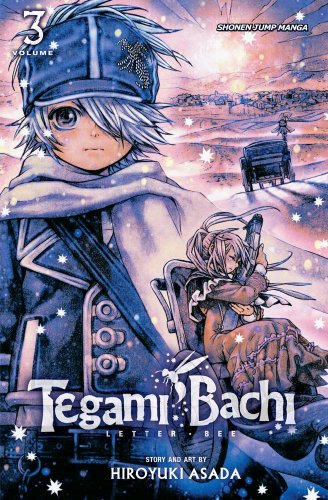
The Jump: Asada Hiroyuki’s TEGAMI BACHI, vols. 3-5


Tegami Bachi, aseries combining elements of off-kilter fantasy and science fiction inlushly-illustrated manga format, took awhile to get off the ground for me. I loved Asada’s heavily-lined, high-contrast, gloomy and angular art, and I was curious about the parceled-out world of Amberground and mystery of the disappearance of a character from the first volume.

The world-building, the suspense and mystery, the art—all of these grabbed me from the beginning, and I didn’t regret buying the volumes, except after the second volume, when I found the narrative wanting.

The focus of the series had apparently changed from one character to another, and the reasons why were not clear. However, after a few months, I missed the art, and picked up the third volume. I’m happy I’ve since bought through volume six (and just today ordered the next three).

The story is coming together better. More clues are revealed. The supporting characters are earning their spots in the narrative. We have liftoff.

For a while, the series felt weighed down also by the silly-sounding names. I realized a bit late that there is a pattern, of sorts, and though the names still sound ridiculous (I’ve written about Jiggy Pepper, a minor character, before, but one of the principal characters is named Gauche Suede, and there are more like that), the development of the protagonist and the hints about the disappeared character outweigh that for me now.

This is definite shonen manga material, with a child protagonist, missing parents, speed lines, obscure catch phrases, and very tame “fanservice” shots of a semi-human character who frequently disrobes. Tegami Bachi is published first in Shonen Jump magazine in Japan and the US, and brought out in volumes in Japanese, English, French, and Italian, at least.


Digital Children's Publishing: Embrace Change or Get Left Behind

I like the point at the end of  Digital Children's Publishing: Embrace Change or Get Left Behind that authors have the opportunity (and the need) to reimagine storytelling as a dynamic process. 

I want to do that!

Sunday, June 10, 2012

Rush, rush... And a review of Veronica Roth's DIVERGENT


May flew by, but not without a bit of exciting reading. 


While setting up my company’s booth at the International Reading Association, I peeked next door and saw a postcard for Insurgent, the sequel to a book on my shelf at home.

“The first book in that series is on the top of my reading list at home,” I told an attendant. Some middle-aged guy working for a tiny publisher of books for the special education market had just admitted to reading a book for teenaged girls. Very suspicious.

And it wasn’t exactly true, but I’m glad I lied. When I got home and saw Divergent, the first book in the series, I started in on it very quickly. It was the most exciting teen novel I’d read since finishing Mockingjay, and that was a year and a half ago. (I read the first five Game of Thrones books in the interim, but that won’t compare very well for all the differences, and I reacted differently to Martin’s fantasy, anyway.)

It was so exciting, the next thing I read (aside from manga, stuff for work, or soccer training materials) was Catching Fire, which I just finished a few hours ago.

The bridges between Divergent and the Hunger Games series are urgency, a compelling dystopian setting, clockwork structure, and well-crafted teenage female leads.

The urgency of Divergent is less existential, at first. The problems Beatrice Prior faces are subtler and less immediately lethal than those faced by Katniss Everdeen. Somehow, the wrenching philosophical and emotional issues Beatrice faces rise to the level of urgency of Katniss’. Rereading Catching Fire reminded me not only how well Suzanne Collins wrote action sequences, but also how well she wrote interior monologue. The strands of conflict and significance revealed in the first chapter follow through each to the last, taut and humming. This is the urgency matched by Veronica Roth in Divergent.

Strange laws, a warped society, alien values or ways of expressing them, the transformation of the familiar into the strange—these are some of the elements that go into a believable dystopia. Both worlds—Panem and Veronica Roth’s Chicago—have somewhat simplistic organizations. Panem has twelve, or maybe thirteen (find out for yourself), districts and a Capitol region, spread out across the former United States. Each produces specific commodities or manufactures a class of products, almost as Roman colonies, but simplified. One district manufactures electronics, one mines coal, one produces textiles, and no others duplicate these categories. Two produce food: one terrestrial and one maritime. Readers can accept this unrealistic situation because the rest of the narrative is so immediately realistic, almost tactile. Collins is especially successful at evoking place, both in terms of sensation and in terms of emotion.

Roth’s Chicago is cleverly transformed in physical terms, but still recognizable. The crucial social organization is simplified and easily understood, but simplistic, the Faction as unrealistic as the Districts of Panem. In place of Districts producing distinct products, each Faction in Divergent subscribes to different values and norms of behavior. This, even more than the differences among districts in The Hunger Games trilogy, adds color to the story line.

This is a good point to make a transition from comparing the dystopias to comparing the high degree of organization common to the Hunger Games trilogy and Divergent. I felt that this was what distinguished Roth’s and Collins’ work from other teen fiction. At each stage, significant details are revealed that either set the stage for later, elaborate on a theme from earlier, or both. The heroine (protoheroine?) Beatrice Prior’s early-revealed fascination with the daring members of the Dauntlesss Faction makes more sense as layers of the society, Beatrice’s past, and her family’s past are revealed, adding layer upon layer of significance to events and situations that seem unimportant or ambiguous.

Collins ratchets up the emotional stress with each additional layer, threatening to overwhelm the reader. Roth weaves the strands of significance back and forth a little less intensely, at least within the first book, but in a similar manner.

One of the similarities in appeal between the Hunger Games trilogy and Divergent is in modeling personalities in the books after real-world teen concerns. In the Hunger Games, children are forced into combat in the arena each year. In Divergent, teens choose their faction at the age of 16, and are initiated or cast out depending on their ability to adapt to completely new rules. This is far more subtle a setup than the Hunger Games, and there’s no central villain in the arrangement, but the most notable difference is that the factions behave a lot like social cliques in some ways. Imagine social cliques with their own laws, territories, and lethal induction ceremonies, as well as hangouts, clothing styles, lingo, and forms of entertainment.

Friday, May 18, 2012

Farewell, Jean Craighead George

Jean Craighead George, prolific author of books that have inspired both me and my son (My Side of the Mountain, anyone?), passed away at the age of 92. 

Her writing is a precursor of the gritty action-adventures, often featuring tough, young women, that sell so well today. (I just finished Divergent, by Veronica Roth, review TK.) I think there's a pretty straight line between JCG and dystopian fantasies.

Thanks, Jean Craighead George, for what you wrote, and for the inventiveness you inspired.