I really meant to write about more than just the books I've finished, and not gotten too busy to write about. (I recently read Rick Riordan's Son of Neptune, the very enjoyable seventh Percy Jackson novel, but nothing irreversible happens in it, and not much is revealed in it, except for two new, kinda fun characters, so I didn't really have any reaction.)
So, in that vein, here's a reaction to something I read while doing image spec research at work. I was looking for a 14 year-old hapa boy (my older son is only 11 but would otherwise suit the character), and found that model-turned-TV-producer (I think) Tyra Banks masterminded a segment of a modeling show (I don't watch TV, and if I did, I don't think I would watch something called "America's Top Model" - I'm not even completely sure that's what her show is called) in which models adopted mixed racial/cultural identities to fit the Hawaiian hapa identity. Only, as one blogger (lost to the mist of ten minutes ago) noted, these were not ethnicities represented in any number on Hawaii. That's stupid, part one.
Stupid, part two is that it all pretty much looks like blackface filtered through a century and a half of increased familiarity with racial and cultural differences and enough political and social sophistication to know that depicting the first not-lily-white president with a bone through his nose is over the top. (Calling him un-American is still OK, though, apparently.) These depictions are very Orientalized (refer to Edward Said, Orientalism) - depictions of people as emblems of cultural and racial difference, posed in costume and makeup to be their identities.
Stupid, part three is the prefixes. One of the models adopted the hapa identity the show called "batswana/polynesian."
Polynesian peoples do have some differences among them, obviously. I felt silly going to the Polynesian Cultural Center in Oahu over a decade ago for one of their performance/luau evenings. It was fun in a Disneyesque way, but with more poi. The creepy part to me was the way the different cultures were represented as variations on grass-skirts, dancing-and-drums, etc. It was unenlightening at best. Still, there is a word "polynesian," built from Greek roots "poly" (many) and "nesos" (islands).
"BaTswana," however, means "Tswana people." One Tswana person is "moTswana." The prefix gives the number and the noun class, a concept shared by Bantu languages, and not Indo-European ones. The simplest way to avoid stupidity when using a Bantu word in a non-Bantu language context is to strip it of the prefix. That would make the imaginary multiethnic label "tswana/polynesian." This is not that hard to find out. The show aired in 2009, according to the websites I read about it. I think there was wikipedia then. Right?
Which is, of course, stupid part four. Going on TV without spending ten minutes on research.
About Me
- Steve Shea
- A 40-ish publisher (editor, project manager, etc.), husband, and father of an even number of offspring, I grew up, or failed to, reading fantasy and sci-fi. I still enjoy reading, and now am trying to write. My favorite books include YA fantasy, manga, biography, and advice to authors. I'm also a former history major/grad student/high school teacher and assessment writer. Now I work for a school supplement publisher, specializing in high-low chapter books. I spend a lot of my time controlling reading levels. At night, I cut loose and use long words. W00t!
Wednesday, November 23, 2011
Monday, November 14, 2011
Woe is... George R. R. Martin's Guilt-Ridden Cast of Thousands
George R. R. Martin’s Song of Ice and Fire series starts with betrayal, execution, and a subtly magical bond between animals and people. After A Game of Thrones and most of A Clash of Kings, I have to conclude that it will not let up. We join the tale when the strands are well enfolded, lines of allegiance and affinity blurred and shifting. I read the story and thrill in the narrative, and despair for humanity.
It is a very human tale, setting and animal intelligence notwithstanding. Sure, there are dragons, but unlike in Martin’s partial namesake and obvious forebear Tolkien’s great works, the motives of people, regardless of access to magical power, are the chief cause of misery.
And Martin shapes that misery like a glassblower, with hammer, tongs, and breath. He twists a character’s fond hopes into wanton disregard for consequences, another’s protective instincts into acts that must be hidden from view at the cost of war and kingdom. There are no guiltless characters. Even the most blameless are wracked by guilt for smaller injuries, perceived and real, to relatives, friends, and allies living and dead.
This would all be terribly gloomy and uninteresting if the characters did not seem so terrifically human. They are not made human by being equally bad and good, or by appealing equally to the moral compass of any group of readers. They are made human by doing good and bad things for real reasons. Prince Joffrey is an insufferable prick, for example, and hugely more important in his own eyes even than his greatest manipulators’, but the way he became that is hinted at from his introduction. Nowhere is his bad behavior blamed on his parents’ frosty marriage or the laxness of guidance for a firstborn prince, but we know the type.
The good characters, too, are bad. Some make foolish choices (Jon Snow at the Skirling Pass in A Clash of Kings, for instance. Yet they make foolish choices for intelligible reasons. I despair of Sansa Stark becoming a whole person before she is destroyed, yet Martin seems to be developing a depth there, perhaps only later to kill her off or make her a pawn in an evil scheme. (Another evil scheme, I mean.)
The Lannisters are almost wholly awful, but fascinating to watch. The narrative is full without much of the father Tywin, but he looms menacingly throughout the second book in the series, promising at any moment to burst on the scene – and burn it to the ground. The daughter Cersei never seems to begin to promise a hint of humanity without redoubling her utter awfulness on the rebound. Her twin brother is less subtly awful, yet fascinating to watch. I think other readers may like me keep hoping he gets some comeuppance that sticks.
The other Lannister brother is the most interesting by far of them. Along with the Stark bastard Jon Snow and his trueborn sister Arya, he moves the story through switchbacks and over precipices. The way the three of them literally traverse space in the narrative seems brighter and sharper as well. Many characters end up somewhere distant, but it seems Jon, Arya, and Tyrion have the most interesting journeys.
Martin is a master not only of plot twists involving a cast of thousands, but also of descriptions of place. I was looking at a service stairway in a Chicago subway on my way back from a business trip today, and realized that it was grey, grimy and worn, probably cool and dry to the touch. I realized that my own places – the places I’ve written about in drafts and stuttering starts – lack the fullness of detail that allows readers to imagine themselves doing what the character is doing.
It may be this or it may be the contingent and frail morals of the characters, and it is more likely both, that brings the impossible stories to life.
This is a more significant accomplishment in the case of the part of the story that takes place off the map supplied in the front of the first two books. I can’t decide why I think Martin provides a map, in some detail, of the small continent of Westeros, while having a significant chunk of the story take place across the Narrow Sea, as it’s called in the narrative (but not labeled on the map).
Perhaps it’s because readers are to think of the events and people there as more exotic, but that seems shallow when compared to Martin’s other devices.
It may be that Martin’s map reflects the view of many of his characters, that over-the-seas is unknown, and denies us a view of it as terra cognita. It may also be related to the prevailing view of magic.
This is one of the issues that, to me, bedevils fantasy. Because magic is so widely considered a childlike interest in our culture (at least, magic not cloaked in widely accepted religious faiths), can a fantasy writer appeal to mature audiences with stories about dragons and spells and wizards and potions?
I think the answer lies somewhere near the observation that all of these magical story elements and more exist in the Song of Ice and Fire series. However, many characters major and minor disbelieve, or are skeptical, or come to question their faiths, despite the evidence in the books of such magics. It is a world in which, to borrow phrases and concepts from Janet Rowling, the wizarding community and muggles live side-by-side, aware of each other, and often sliding across the boundaries.
I have a few more chapters left, and then I have to make a fateful decision. Do I continue to race through the available volumes in the series, ensuring that I’ll finish reading years before Martin can come out with another epic volume of this epic, or do I break the spell and read the next book in the pile? This is a hard one.
Sunday, October 16, 2011
Midnight for Charlie Bone, by Jenny Nimmo
This was kind of a wild guess, and it worked out. And yet...
I can't recall how I wound up with this - a gift, maybe? I didn't like the title, or the cover, and the beginning of the book didn't move me, but I needed something to read that both the boys (3 1/2 years apart) would enjoy me reading to them at bedtime. It hit the spot.
From my perspective, however, the story felt thin. It's hard to not compare two books about a timid, adolescent English boy with magical gifts escaping his unhappy home situation by entering a dangerous and fascinating magical academy. Unfortunately for Jenny Nimmo, Janet Rowling is a terrific writer, and Harry Potter casts a long shadow.
I don't think Nimmo meant to derive from Rowling's books, and there are certainly no wands or explosions, but Charlie is missing one parent, in mysterious circumstances, has unmanageable hair, and quickly makes two friends and one dreadful enemy at the magical academy.
What actually bothered me about the book was that it felt washed out, paler, thinner. It was like being in the shower when the hot water starts to run out. It's not cold, exactly, but you remember how warm it was just before.
None of the conflicts grabbed me viscerally. I felt bad for Charlie, but in a passing way. And when his uncle Paton (the most interesting character in the book) begins to exert himself, it was never heroic, or startling, just kind of a relief, that someone in the story seemed to care.
I think another unfairness in my impression is that I read the book out loud. It's a slightly different experience, and some books fare better than others. Jeanne Birdsall's Penderwick books feature very small events writ large in the characters' consciousness. In Nimmo's first Charlie Bone book, somewhat the opposite seems to have happened. Portentous events slip by, unappreciated.
As a wannabe writer, I pay attention to this, which may be why, as a reader, it makes this much difference to me. The kids certainly liked the story, and are looking forward to the next installment.
My older son just woke up and confirmed that he loved the book, and it wasn't boring for a second. So there.
I can't recall how I wound up with this - a gift, maybe? I didn't like the title, or the cover, and the beginning of the book didn't move me, but I needed something to read that both the boys (3 1/2 years apart) would enjoy me reading to them at bedtime. It hit the spot.
From my perspective, however, the story felt thin. It's hard to not compare two books about a timid, adolescent English boy with magical gifts escaping his unhappy home situation by entering a dangerous and fascinating magical academy. Unfortunately for Jenny Nimmo, Janet Rowling is a terrific writer, and Harry Potter casts a long shadow.
I don't think Nimmo meant to derive from Rowling's books, and there are certainly no wands or explosions, but Charlie is missing one parent, in mysterious circumstances, has unmanageable hair, and quickly makes two friends and one dreadful enemy at the magical academy.
What actually bothered me about the book was that it felt washed out, paler, thinner. It was like being in the shower when the hot water starts to run out. It's not cold, exactly, but you remember how warm it was just before.
None of the conflicts grabbed me viscerally. I felt bad for Charlie, but in a passing way. And when his uncle Paton (the most interesting character in the book) begins to exert himself, it was never heroic, or startling, just kind of a relief, that someone in the story seemed to care.
I think another unfairness in my impression is that I read the book out loud. It's a slightly different experience, and some books fare better than others. Jeanne Birdsall's Penderwick books feature very small events writ large in the characters' consciousness. In Nimmo's first Charlie Bone book, somewhat the opposite seems to have happened. Portentous events slip by, unappreciated.
As a wannabe writer, I pay attention to this, which may be why, as a reader, it makes this much difference to me. The kids certainly liked the story, and are looking forward to the next installment.
My older son just woke up and confirmed that he loved the book, and it wasn't boring for a second. So there.
Wednesday, October 12, 2011
Anne R. Allen's Blog: 12 Dos and Don'ts for Introducing your Protagonist...
For writers, this is worth reading: a short and crisp to-don't list for final-drafting your main character's introduction. I don't just understand the points, I feel them.
Now if only I could write my darned book!
Anne R. Allen's Blog: 12 Dos and Don'ts for Introducing your Protagonist...: I've been dealing with an evil computer virus which first attacked my desktop and now seems to have killed my laptop dead. They're both old ...
Now if only I could write my darned book!
Anne R. Allen's Blog: 12 Dos and Don'ts for Introducing your Protagonist...: I've been dealing with an evil computer virus which first attacked my desktop and now seems to have killed my laptop dead. They're both old ...
Friday, October 7, 2011
update on no updates (blaming an author)
It's not Lesley Hauge's fault that I haven't written about her rewarding and fast-paced book Nomansland. It's a great read. I am looking forward to the sequel. If you want something postapocalyptic about as fresh and creative as Jeanne du Prau's The City of Ember and its sequels, and are willing to get a little more grown up in the topics and treatment, this is an excellent choice. Big ideas. Absorbing characters. Fast pace. Definite room for sequels.
I can't wait.
But I have to. It's George R. R. Martin's fault. (R. R. = Ronald Reuel?) I am losing sleep over A Game of Thrones. If by any chance you have a vague liking for medievalish fantasy, can handle multiple characters and occasional ladlesful of information (mostly doled out in teaspoons), and if you like losing sleep, this is highly recommended. It's got to be about five times as long as Nomansland, and it's definitely for grown-ups, even though many of the characters are quite young, and they don't get spared.
Come to think of it, that's probably really why it's for adults. It's not the sex, or the violence, or the serious matters of state. It's that kids are in the middle of it, in one way or another. (Kids who do read the book will acquire useful vocabulary, including portcullis, bastard, gremkin, and saddle-sore. Only two of these terms are involved in sex, at least in the first 200 pages.)
Frankly, I picked up Martin's book despite the HBO series advertised on the cover, and I'm dreading seeing the adaptation. (I'm safe for now, mostly because I don't have cable.) The book is so absorbing this far that the drama is almost sure to sicken me with disappointment.
I can't wait.
But I have to. It's George R. R. Martin's fault. (R. R. = Ronald Reuel?) I am losing sleep over A Game of Thrones. If by any chance you have a vague liking for medievalish fantasy, can handle multiple characters and occasional ladlesful of information (mostly doled out in teaspoons), and if you like losing sleep, this is highly recommended. It's got to be about five times as long as Nomansland, and it's definitely for grown-ups, even though many of the characters are quite young, and they don't get spared.
Come to think of it, that's probably really why it's for adults. It's not the sex, or the violence, or the serious matters of state. It's that kids are in the middle of it, in one way or another. (Kids who do read the book will acquire useful vocabulary, including portcullis, bastard, gremkin, and saddle-sore. Only two of these terms are involved in sex, at least in the first 200 pages.)
Frankly, I picked up Martin's book despite the HBO series advertised on the cover, and I'm dreading seeing the adaptation. (I'm safe for now, mostly because I don't have cable.) The book is so absorbing this far that the drama is almost sure to sicken me with disappointment.
Thursday, October 6, 2011
missing "e" complaint
It's raining.
Herman Cain is the Republican favorite.
Steve Jobs is dead.
What am I complaining about? (Warning: I am about to complain.)
I am complaining about a missing "e" in a comic.
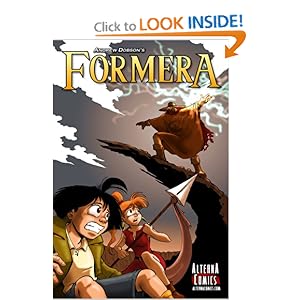
I followed a link from deviantart to the amazon page for a comicker I didn't know - Andrew Dobson. His new series Formera has two volumes out, and in the first, the "look inside" sample has a misspelling on the third page included. (It's probably page 2, but I can't tell if the first is a title page, the cover, or page 1).
The error? Boy falls from sky into water. Reaction? "I can't breath!"
Come on. There are twenty words to a page in this comic. Six editors had to have looked at that. The text editor for blogger (TM) highlights misspelled words!
Fer cryin' out loud!
Herman Cain is the Republican favorite.
Steve Jobs is dead.
What am I complaining about? (Warning: I am about to complain.)
I am complaining about a missing "e" in a comic.
I followed a link from deviantart to the amazon page for a comicker I didn't know - Andrew Dobson. His new series Formera has two volumes out, and in the first, the "look inside" sample has a misspelling on the third page included. (It's probably page 2, but I can't tell if the first is a title page, the cover, or page 1).
The error? Boy falls from sky into water. Reaction? "I can't breath!"
Come on. There are twenty words to a page in this comic. Six editors had to have looked at that. The text editor for blogger (TM) highlights misspelled words!
Fer cryin' out loud!
Monday, October 3, 2011
a "makers versus takers" type email
I was distressed that a friend forwarded this email:
And I had this response:
People who do not pay income taxes (because they have little or no income) pay sales taxes. Many of them get “free stuff” in the form of temporary aid. Some of them get “free stuff” in the form of temporary aid that lasts a long time. This is a problem because they are consuming and not producing.
People who do not pay income taxes (because they have a lot of money, and spend a small portion of it to shield a greater portion from taxation) pay sales taxes. many of them get “free stuff” in the form of access to roads and bridges, fire and police protection, clean water, hurricane warnings and the like. This is a problem because the system that everyone else pays for allows them to benefit enormously without contributing to the system.
People who do pay income taxes make up the majority of Americans. They also pay sales taxes. Their tax payments educate the vast majority of the future doctors, engineers, and construction workers – of all of us. Their tax payments allow governments to build and maintain roads and bridges, test cantaloupes for dangerous bacteria, and inspect cost-cutting/profit-maximizing airlines’ planes before takeoff. They also own the airwaves that the government they pay for licenses to broadcasters. This is good because the people who pay the taxes by law make the decisions, however indirectly, in government.
This is where it gets interesting. The people who don’t pay income taxes (because they have enough money to shield their money) own a lot of broadcast media. They do it as individuals, as corporations, and as interest groups. They are a bit scared of the people who do pay most of the income taxes. They have a choice: fight us (hard) or co-opt us (not quite as hard). They have tools for fighting (bloody) and tools for co-option (less bloody).
I’m glad they chose the easier, less bloody route of telling you what to think. Now I am still alive to tell you what I think. I think they are filling your head with misinformation.
If there’s a class war, who won? The people who are out of work and hopeless and still sitting on their hands, or the people who are comfortable and well-fed and in control of media and government? Or, to use the original writer’s metaphor, the wealthiest are the wolves.
I have to get back to work if I’m going to continue supporting public education (my kids are in school right now), the interstate highway system (how I get to work and how my food gets to the grocery store), the public utilities commission (which helps keep electricity rates down so my boss can keep the lights on), et cetera, ad nauseam.
Stay well,
Steve
---
I think I was very diplomatic. Now I really have to get back to work!
Subject: FW: FREE STUFF....
Worth reading.
>
>
> I have never heard this said as plain or as well.
>
> Class war at its best.
>
> The folks who are getting the free stuff, don't like the folks who are
> paying for the free stuff, because the folks who are paying for the free
> stuff, can no longer afford to pay for both the free stuff and their own
> stuff.
>
>
>
> And,
>
>
>
> The folks who are paying for the free stuff, want the free stuff to stop and
> the folks who are getting the free stuff,
>
> want even more free stuff on top of the free stuff they are already getting.
>
>
>
> Now... The people who are forcing the people who Pay for the free stuff,
> have told the people who are RECEIVING the free stuff, that the people who
> are PAYING for the free stuff, are being mean, prejudiced, and racist.
>
>
>
> So, the people who are GETTING the free stuff, have been convinced they need
> to hate the people who are paying for the free stuff, by the people who are
> forcing some people to pay for their free stuff, and giving them the free
> stuff in the first place.
>
>
>
> We have let the free stuff giving go on for so long that there are now more
> people getting free stuff than paying for the free stuff.
>
>
>
> Now understand this. All great democracies have committed financial suicide
> somewhere between 200 and 250 years after being founded. The reason? The
> voters figured out they could vote themselves money from the treasury by
> electing people who promised to give them money from the treasury in
> exchange for electing them.
>
>
>
> The United States officially became a Republic in 1776, 231 years ago. The
> number of people now getting free stuff outnumbers the people paying for the
> free stuff. We have one chance to change that in 2012. Failure to change
> that spells the end of the United States as we know it.
>
>
>
> ELECTION 2012 IS COMING
>
> A Nation of Sheep Breeds a Government of Wolves.
>
> I'M 100% for PASSING THIS ON.
>
> Let's Take a Stand.
>
>
>
>
> Obama: Gone.
>
> Borders: Closed.
>
> Language: English only.
>
> Culture: Constitution, and the Bill of Rights.
>
> Drug Free: Mandatory Drug Screening before Welfare.
>
> NO freebies to: Non-Citizens.
>
> We the people are coming....
>
>
> Only 86% will send this on. Should be 100%. What will you do?
>
And I had this response:
People who do not pay income taxes (because they have little or no income) pay sales taxes. Many of them get “free stuff” in the form of temporary aid. Some of them get “free stuff” in the form of temporary aid that lasts a long time. This is a problem because they are consuming and not producing.
People who do not pay income taxes (because they have a lot of money, and spend a small portion of it to shield a greater portion from taxation) pay sales taxes. many of them get “free stuff” in the form of access to roads and bridges, fire and police protection, clean water, hurricane warnings and the like. This is a problem because the system that everyone else pays for allows them to benefit enormously without contributing to the system.
People who do pay income taxes make up the majority of Americans. They also pay sales taxes. Their tax payments educate the vast majority of the future doctors, engineers, and construction workers – of all of us. Their tax payments allow governments to build and maintain roads and bridges, test cantaloupes for dangerous bacteria, and inspect cost-cutting/profit-maximizing airlines’ planes before takeoff. They also own the airwaves that the government they pay for licenses to broadcasters. This is good because the people who pay the taxes by law make the decisions, however indirectly, in government.
This is where it gets interesting. The people who don’t pay income taxes (because they have enough money to shield their money) own a lot of broadcast media. They do it as individuals, as corporations, and as interest groups. They are a bit scared of the people who do pay most of the income taxes. They have a choice: fight us (hard) or co-opt us (not quite as hard). They have tools for fighting (bloody) and tools for co-option (less bloody).
I’m glad they chose the easier, less bloody route of telling you what to think. Now I am still alive to tell you what I think. I think they are filling your head with misinformation.
If there’s a class war, who won? The people who are out of work and hopeless and still sitting on their hands, or the people who are comfortable and well-fed and in control of media and government? Or, to use the original writer’s metaphor, the wealthiest are the wolves.
I have to get back to work if I’m going to continue supporting public education (my kids are in school right now), the interstate highway system (how I get to work and how my food gets to the grocery store), the public utilities commission (which helps keep electricity rates down so my boss can keep the lights on), et cetera, ad nauseam.
Stay well,
Steve
---
I think I was very diplomatic. Now I really have to get back to work!
Subscribe to:
Posts (Atom)